
Servo Motor Selection Guide
Release Time:
2024-10-31
Servo motors are widely used in the field of modern industrial automation. They outperform stepper motors with high precision, high response speed, and stable performance, providing powerful power support for various industrial equipment and serving as the core of all types of industrial equipment. Next, we will learn about the selection of servo motors from their composition.
Servo motors are widely used in the field of modern industrial automation. They outperform stepper motors with high precision, high response speed, and stable performance, providing powerful power support for various industrial equipment and serving as the core of all types of industrial equipment. Next, we will learn about the selection of servo motors from their composition.
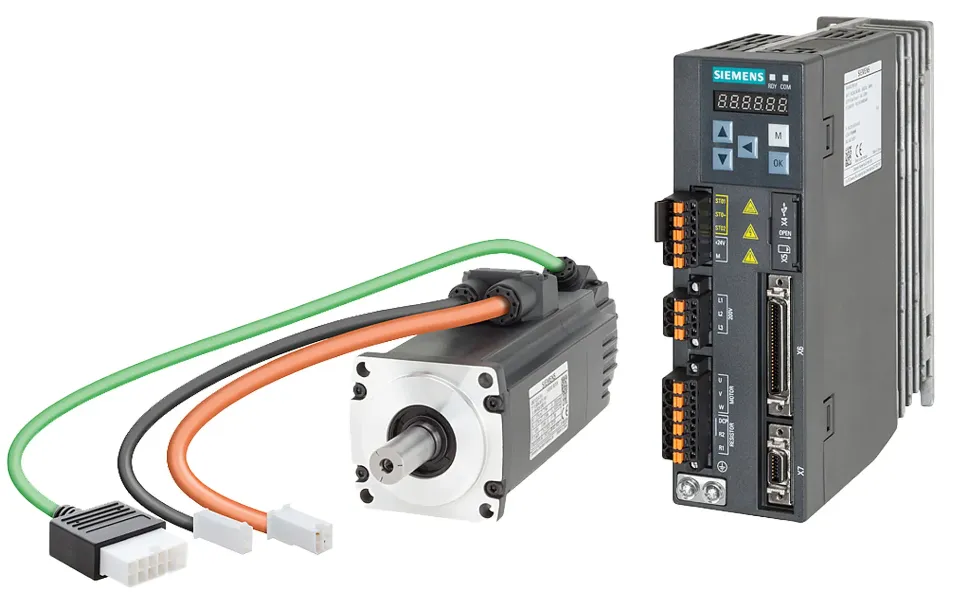
Among the numerous classifications of servo motors, there are different classifications and choices in terms of encoder type, inertia size, shaft type, driver form, and connection wire type.
Speed fbk sel
Servo motors can be divided into two categories from the perspective of encoders: absolute and incremental. Among them, absolute encoders are further divided into battery type and non battery type.
Absolute encoder:
Battery type: The battery type absolute encoder uses a battery to store the position information of the motor. Even if the power is disconnected, the encoder can maintain its memory of the motor position due to the battery power supply. Encoders from Mitsubishi, Panasonic, and Delta are battery free encoders that achieve absolute value function through the addition of a battery. Without a battery, they provide incremental function. This type of encoder is suitable for situations that require long-term operation and frequent power outages, as it ensures that the motor can accurately return to its previous position after power is restored, without the need for origin regression operation.
Battery free: The battery free absolute encoder records the position information of the motor through mechanical or magnetic means, without the need for battery power supply. They have a longer service life and lower maintenance costs. Although they cannot maintain their position information after the power is disconnected, this is not a problem in many applications as they can determine their current position through other means such as initialization sequences after being powered back on.
Incremental encoder: It determines the position by recording the relative displacement of the motor rotation, and it requires initial position information (returning to the origin) to accurately locate, which is quite troublesome.
Inertia size
Servo motors can be classified into three types based on their inertia: large, medium, and small.
High inertia motor: It has good stability and heavy load capacity, suitable for working under high-speed operation and high load conditions.
Small inertia motor: With higher response speed and acceleration, it is suitable for situations that require fast response and precise control.
Type of axis
There are various types of shafts for servo motors, including those with oil seals, those without oil seals, those with keyway openings, and those with holes.
Shaft with oil seal: It can prevent lubricating oil leakage and is suitable for situations that require long-term stable operation and harsh working environments.
Keyways and drilled shafts: convenient for connecting and fixing with other mechanical components.
Drive type
Drivers, as an important component of servo motors, are divided into two types: pulse type and bus type.
Pulse type driver: controls the rotation of the motor by receiving pulse signals, suitable for simple control requirements.
There are usually several ways of pulse control:
1. Forward and reverse pulse: By outputting different pulses, control the forward and reverse directions
2. Pulse+direction: It operates through high-speed pulse output and direction model, and the advantage of this control scheme is that it can save high-speed pulse output points.
3. AB phase pulse: also known as differential output
In summary, servo motors have a wide and diverse range of applications in the field of industrial automation. When choosing a servo motor, it is necessary to comprehensively consider factors such as encoder type (including battery and non battery absolute encoders), inertia size, shaft type, driver type, and connection wire type based on specific application scenarios and requirements. Only by selecting appropriate servo motors and configurations can the stable operation and efficient production of industrial equipment be ensured.
Related News