
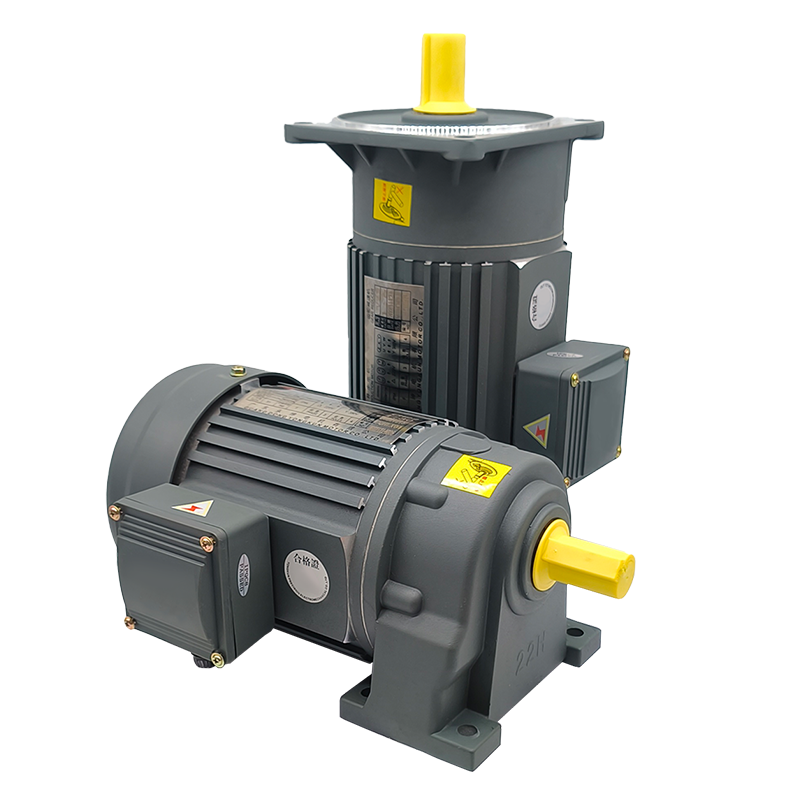
Why does your Little Diamond reducer always get damaged?
Release Time:
2024-10-30
1. Fast wear rate: Due to factors such as machining, assembly, and debugging of new gear reducer components, the contact area of the mating surface is small, while the allowable torque is large. During the operation of the gear reducer, the concave and convex parts on the surface of the parts are interlocked and rubbed against each other, and the metal debris that falls off is used as abrasive to continue to participate in friction, further accelerating the wear of the mating surface of the parts. Therefore, during the running in period, it is easy to cause wear and tear of components (especially mating surfaces), and the wear rate is too fast. At this point, if overloaded operation occurs, it may lead to damage to components and early failure.
There are generally several reasons for damage to the small diamond gear reducer, including:
1. Fast wear rate: Due to factors such as machining, assembly, and debugging of new gear reducer components, the contact area of the mating surface is small, while the allowable torque is large. During the operation of the gear reducer, the concave and convex parts on the surface of the parts are interlocked and rubbed against each other, and the metal debris that falls off is used as abrasive to continue to participate in friction, further accelerating the wear of the mating surface of the parts. Therefore, during the running in period, it is easy to cause wear and tear of components (especially mating surfaces), and the wear rate is too fast. At this point, if overloaded operation occurs, it may lead to damage to components and early failure.
2. Multiple operational errors: Due to insufficient understanding of the structure and performance of the deceleration motor (especially for new operators), it is easy to cause malfunctions and even mechanical and safety accidents due to operational errors.
3. Poor lubrication: Due to the small fitting clearance of newly assembled components and assembly reasons, lubricating oil (grease) is not easy to form a uniform oil film on the friction surface to prevent wear. This reduces lubrication efficiency and causes early abnormal wear of the components. In severe cases, it can cause scratches or biting on the friction surface of precision fit, leading to the occurrence of faults.
4. Loosening: Newly processed and assembled components have deviations in geometric shape and fitting dimensions. In the early stages of use, due to alternating loads such as impact and vibration, as well as factors such as heat and deformation, coupled with rapid wear and tear, it is easy for the originally fastened components to loosen.
5. Leakage phenomenon: Due to the looseness and vibration of parts and the influence of heat on the gear reducer, leakage may occur on the sealing surface and pipe joints of the gear reducer; Partial casting defects are difficult to detect during assembly and debugging, but due to vibration and impact during the operation, these defects are exposed and manifested as oil leakage (seepage).
Related News