
Turbine screw lift, screw lift
Release Time:
2024-10-29
Check the elevator car and guide rails: The elevator car is the part that carries objects, and it is necessary to ensure that the structure of the elevator car is intact, without deformation or damage. The guide rail is the guiding device for elevator car lifting, and it is necessary to check the straightness and smoothness of the guide rail. If the guide rail is deformed or worn, the elevator car may experience shaking or jamming during the lifting process, affecting the normal use of the elevator.
Turbolift typically consists of a motor, turbine, worm gear, car (or lifting platform), and other components. The motor drives the turbine to rotate, and the turbine meshes with the worm. The rotation of the worm drives the elevator car to move up and down along the guide rail. The turbine worm drive has self-locking properties, which allows the elevator to remain in its current position when it stops running and will not slide down on its own due to gravity, increasing safety. For example, in some small cargo elevators, when the motor stops working, the self-locking characteristic of the worm gear can ensure that the cargo stays at the appropriate height, facilitating loading and unloading operations.
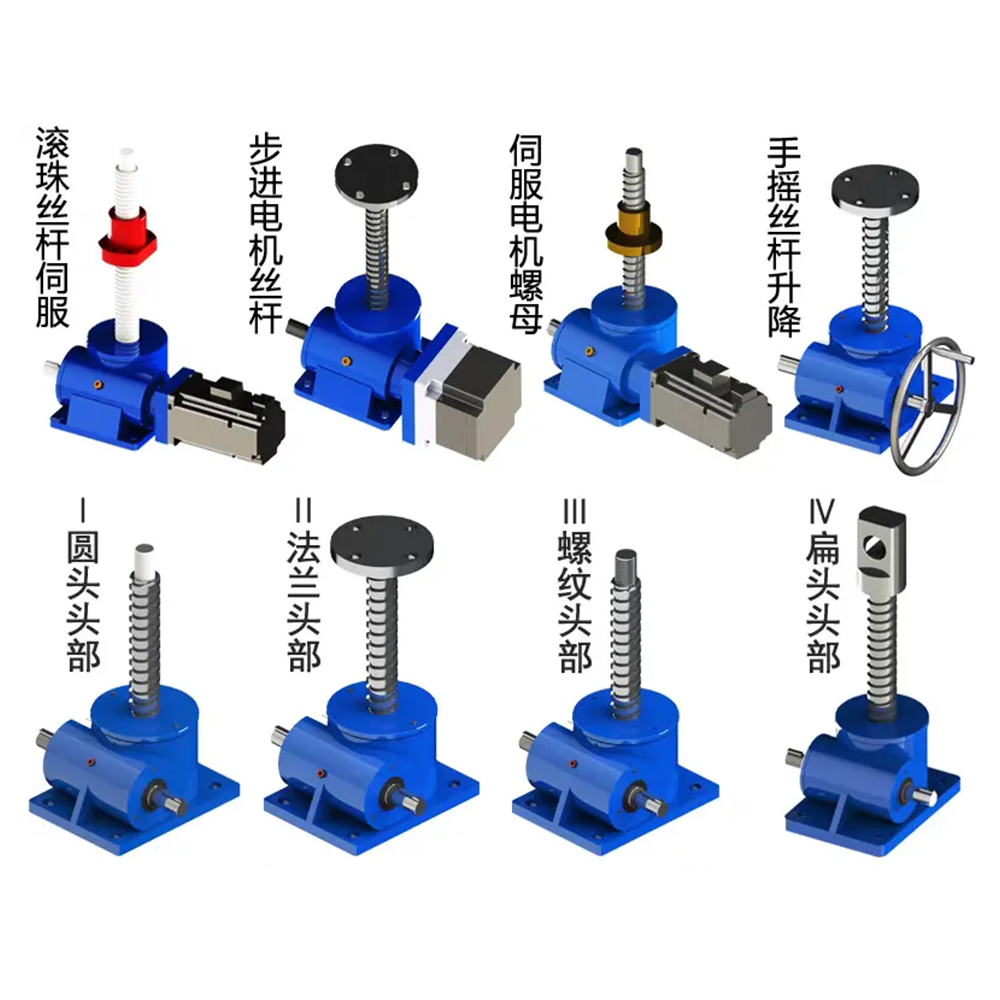
The spiral elevator is driven by a worm gear, which drives the lead screw to rotate and complete functions such as rising, falling, pushing, pulling, and flipping. It can be combined with power sources, steering gear, and other accessories to form a working platform for simultaneous lifting and lowering. It can also be installed and used as a single unit, and can be electric or manual.
Spiral screw elevator can be equipped with dust cover, anti backlash design, 1-ton screw elevator, safety nut, screw elevator, ball screw, limit switch, overload clutch, potentiometer, encoder, brake, hand crank, installation accessories, etc. The accuracy can reach 0.1mm, and the accuracy with anti backlash accessories can reach 0.04mm. The turbine screw lift has strong impact resistance, high mechanical synchronization accuracy, and smooth operation.
The screw lift has the advantages of compact structure, small volume, light weight, wide power source, low noise, easy installation, flexible use, multiple functions, multiple supporting forms, high reliability, and long service life.
The maximum input speed is 1500r/min, and the fastest lifting speed is 2.7m/min. There are different structural types and assembly methods, and the height is manufactured according to the user's requirements. This device can be self-locking.
Maintenance and upkeep
Regularly inspect the turbine and worm: check the wear of the turbine and worm, as they are key transmission components of the elevator. If the wear is excessive, it will affect the performance and safety of the elevator. It is usually necessary to regularly clean the oil and impurities on the surface of the turbine and worm, and to check and adjust their meshing condition at regular intervals (such as six months or one year, depending on the frequency of use).
Check the motor and electrical system: The motor is the power source of the elevator, and the operating status of the motor should be checked, including whether the temperature, current, and other parameters of the motor are normal. At the same time, inspect the electrical control system to ensure that various control buttons, limit switches, etc. are functioning properly. If a malfunction is found in the electrical system, it is necessary to have it repaired by professional personnel in a timely manner to avoid safety accidents.
Check the elevator car and guide rails: The elevator car is the part that carries objects, and it is necessary to ensure that the structure of the elevator car is intact, without deformation or damage. The guide rail is the guiding device for elevator car lifting, and it is necessary to check the straightness and smoothness of the guide rail. If the guide rail is deformed or worn, the elevator car may experience shaking or jamming during the lifting process, affecting the normal use of the elevator.
Related News