
Introduction to the composition of each part of the motor
Release Time:
2024-10-18
The combination and design of these components depend on the type of motor (such as DC motor, AC motor, stepper motor, servo motor, etc.) and application requirements. The design and manufacturing of motors need to consider factors such as efficiency, reliability, cost, and maintenance.
An electric motor is a complex mechanical device, and its design and construction can be very diverse, but most motors include the following basic components:
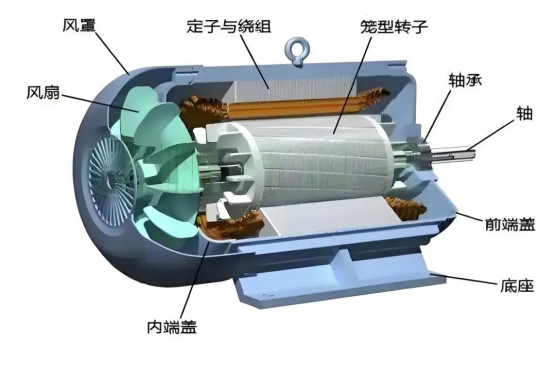
1. Stator:
The stator is the stationary part of a motor, typically composed of an iron core and windings.
The iron core is usually made of stacked silicon steel sheets to reduce eddy current losses.
A winding is a wire wound in a core slot to generate a magnetic field.
2. Rotor:
The rotor is the rotating part of a motor, which can be solid or composed of an iron core and windings.
The rotor core is also made of stacked silicon steel sheets, and the winding varies depending on the type of motor.
3. Bearing:
Bearings support the motor shaft, reducing shaft friction and ensuring smooth rotation of the rotor.
Bearings can be rolling bearings or sliding bearings.
4. Shaft:
A shaft is a component that connects the rotor and external machinery, used to transmit torque.
The material and design of the shaft depend on the load and speed.
5. End Cover/End Shield:
The end caps are fixed at both ends of the stator to protect internal components and prevent foreign objects from entering.
End caps also help maintain the integrity of the motor structure.
6. Brush (DC motor only):
The brush is made of conductive material and is used to slide on the commutator to provide current.
The brush material needs to have good conductivity and wear resistance.
7. Commutator (DC motor only):
A commutator is a mechanical component used to automatically change the direction of current when a motor rotates.
The commutator is composed of multiple commutator segments that come into contact with the brush.
8. Fan:
Fans are used to cool motors and prevent damage due to overheating.
Fans can be built-in or external.
9. Terminal Box:
The junction box is the electrical connection part of the motor, used for connecting power and control circuits.
A junction box typically contains terminal blocks and protective devices.
10. Cooling System:
In large motors, water or air cooling systems may be included to improve cooling efficiency.
11. Protective Device:
Such as overload protectors, short-circuit protectors, etc., used to protect motors from damage.
12. Encoder:
The encoder provides feedback signals for motor speed and position for precise control.
Encoders can be incremental or absolute.
13. Coupling:
Couplings are used to connect motor shafts and load shafts, transmit torque, and sometimes adjust alignment.
14. Brake:
Brakes are used to control the rotation of motors, achieving rapid stopping or positioning.
15. Insulation material:
Insulation materials are used to prevent current leakage and short circuits, and to protect motor windings.
16. Seals:
Seals are used to prevent liquids and dust from entering the interior of the motor.
17. Ventilation System:
The ventilation system is used to dissipate the heat inside the motor.
18. Sensor:
Sensors are used to monitor the temperature, vibration, etc. of motors to prevent malfunctions.
19. Inverter (for certain applications only):
Frequency converters are used to control the speed and torque of AC motors, achieving precise control.
20. Controller:
The controller is used to receive instructions and control the start, stop, and speed of the motor.
The combination and design of these components depend on the type of motor (such as DC motor, AC motor, stepper motor, servo motor, etc.) and application requirements. The design and manufacturing of motors need to consider factors such as efficiency, reliability, cost, and maintenance.
Related News