
The installation essentials and application of reducers
Release Time:
2025-07-31
The correct installation and reasonable application of reducers are the key to ensuring their efficient operation and extending their lifespan. The following is a systematic review from three aspects: installation essentials, application scenarios and selection points, and maintenance precautions:
The installation essentials and application of reducers
The correct installation and reasonable application of reducers are the key to ensuring their efficient operation and extending their lifespan. The following is a systematic review from three aspects: installation essentials, application scenarios and selection points, and maintenance precautions:
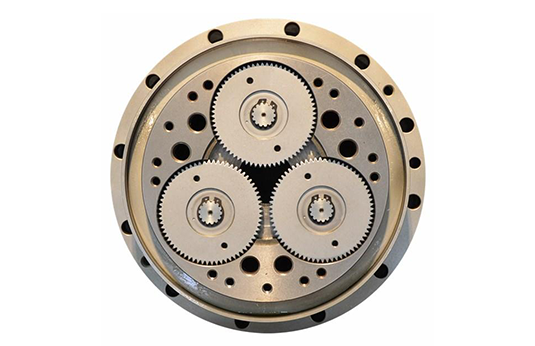
1、 Core installation essentials
Axis alignment and connection
Alignment accuracy: The axis alignment error between the reducer, power source (motor), and working machine should be less than the allowable compensation amount of the coupling, otherwise it may cause bearing damage, output shaft fracture, or abnormal gear wear.
Connection method:
Do not hammer the transmission components (gears, sprockets, etc.) installed on the output shaft. Use assembly fixtures and threaded holes on the shaft end, and press them in with bolts.
Priority should be given to using elastic couplings to avoid additional loads caused by installation deviations of rigid couplings.
Basic fixation and shock absorption
The reducer needs to be installed on a horizontal and rigid foundation/base, with sufficient depth of anchor bolts and a gasket thickness of ≥ 1mm. Loose foundations can cause vibration noise and accelerate bearing gear damage.
In high vibration situations, positioning pins or shock absorbers should be added, and the cooling air duct should be ensured to be unobstructed.
Lubrication and sealing preparation
Clean the joint surface of the shaft and flange before installation, remove rust proof oil (wipe with gasoline), and ensure a tight fit.
Oil level check: Before operation, replace the vent plug and add oil until the oil level plug overflows.
Long term storage (>4 months) requires checking the elasticity of the sealing ring to prevent adhesion failure.
Trial operation specifications
No load operation for ≥ 2 hours, standard: no vibration, abnormal noise, leakage, impact, normal temperature rise.
When loading, it is necessary to start in stages and it is strictly prohibited to run directly at full load.
2、 Application scenarios and selection criteria
Common types and applicable fields
Precision planetary reducer: high rigidity, backlash ≤ 1 arc minute, suitable for servo motors/stepper motors (robots, CNC machine tools), with increasing torque and matching inertia, capable of withstanding -25 ℃~100 ℃.
RV worm gear reducer: large reduction ratio, self-locking, used for lifting equipment, to avoid axial stress.
Cycloid pinwheel reducer: impact resistant, capable of continuous operation for 24 hours (mining machinery), with the output shaft vertically downward when installed vertically.
Key parameters for selection
Torque and speed: The output torque of industrial grade planetary reducers is usually ≤ 2000Nm, and the input speed is ≤ 18000rpm (the larger the size, the lower the speed).
Environmental adaptability:
Temperature: Standard type (-25 ℃~100 ℃), special lubricating grease is required for ultra-low/high temperature.
Protection level: IP65 or above is selected for dusty environments, and anti-corrosion coating is required for humid environments.
3、 Maintenance and Precautions
Regular maintenance
Oil change cycle: 300-400 hours, followed by oil change every 1500-2000 hours thereafter; The inspection for high temperature/dust environment will be shortened to half a month.
Seal inspection: If there is oil leakage from the shaft extension, the oil seal should be replaced immediately to prevent impurities from entering.
Operation monitoring
Monitor abnormal noise (signs of bearing damage), monitor temperature rise (normal within ambient temperature+50 ℃).
Torque protection devices (such as safety couplings) must be installed in overload situations.
Special installation scenarios
Tilt installation: The allowable tilt angle of the cycloidal pinwheel reducer is ≤ 15 °, and the amount of lubricating oil needs to be increased.
Vertical installation: When installing the flange vertically, the output shaft should be facing downwards to avoid insufficient lubrication.
Related News