
Explosion proof asynchronous motor
Release Time:
2025-07-24
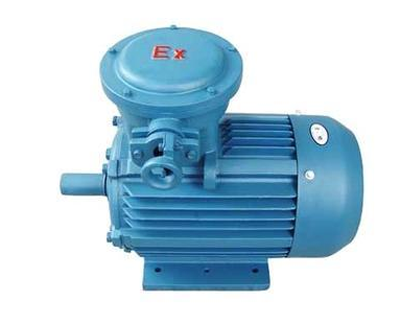
Explosion proof asynchronous motor is a type of motor with explosion-proof function, mainly used in places with hazardous environments such as explosive gases or dust, such as coal mines, petrochemicals, and other fields. Explosion proof asynchronous motors are mainly composed of three parts: stator, rotor, and other accessory components.
Explosion proof asynchronous motor
Explosion proof asynchronous motor is a type of motor with explosion-proof function, mainly used in places with hazardous environments such as explosive gases or dust, such as coal mines, petrochemicals, and other fields. Explosion proof asynchronous motors are mainly composed of three parts: stator, rotor, and other accessory components.
The speed of an electric motor is the frequency f of the power supply multiplied by 60 divided by the magnetic logarithm n. For example, for a 4-motor motor, the magnetic logarithm is 2, and the rated speed is 50HZ × 60 ÷ 2=1500 revolutions per minute. Typically, asynchronous explosion-proof motors have an actual speed of around 1470 revolutions per minute due to the presence of slip rate.
1、 Structure
1. Stator section:
1) Stator core: usually composed of silicon steel sheets with good magnetic conductivity, it is a part of the motor magnetic circuit and used for magnetic conductivity.
2) Stator winding: placed in the circular slot inside the stator core, usually made of high-strength polyester enameled round copper wire, etc. It is the conductive part of the motor, and can generate a rotating magnetic field when three-phase AC power is applied.
Machine frame: used to fix the stator core and end cover, generally made of cast steel or welded steel plate structure, with strong mechanical strength and rigidity, able to withstand internal explosive pressure, while ensuring the overall stability of the motor.
2. Rotor section:
1) Rotor iron core: also made of stacked silicon steel sheets, it is also a part of the magnetic circuit, with evenly distributed slots on its outer surface for placing rotor windings.
Explosion proof enclosure: This is a key component of explosion-proof asynchronous motors. The shell must be able to withstand the explosive pressure generated when the explosive gas mixture inside detonates, while preventing the explosive products from penetrating the explosion-proof gap and igniting the explosive mixture around the shell. The joint surfaces of various components of the shell, such as the explosion-proof joint surfaces between the shell and the end cover, the junction box seat and cover, etc., have strict size and roughness requirements.
3. Other components: including bearings, generally low vibration and low-noise bearings are selected to ensure smooth operation of the motor; Fans are often made of cast aluminum, cast iron, or welded steel plates, and are connected to the shaft with keys for heat dissipation; The wind cover is made of steel plate structure, which ensures smooth ventilation while preventing foreign objects from entering.
2、 Working principle
The working principle of explosion-proof asynchronous motors is the same as that of ordinary asynchronous motors. Taking a three-phase asynchronous motor as an example, when a symmetrical three-phase AC voltage is applied to the stator winding, three-phase symmetrical currents pass through the stator winding, and they jointly generate a stator rotating magnetic field that rotates in the circumferential direction at synchronous speed.
The magnetic field lines of the rotating magnetic field cut through the rotor conductor. According to the law of electromagnetic induction, an electric potential is induced in the rotor conductor, and under the action of this potential, a current flows through the rotor conductor. The active component of the rotor conductor current is in phase with the potential. According to the law of electromagnetic force, the rotor conductor current interacts with the rotating magnetic field, causing the rotor conductor to be subjected to electromagnetic force. Under the action of electromagnetic force, the rotor begins to rotate in the same direction as the rotating magnetic field.
It should be noted that the rotor speed cannot reach the speed of the rotating magnetic field, and there is a certain difference between the two, known as "asynchronous". The reason why the rotor of an asynchronous motor can rotate is because the rotor speed is slower than the synchronous speed (there is a slip), so that the stator rotating magnetic field can "cut" the rotor conductor, generate induced current and electromagnetic force (similar to the process of "chasing"). The larger the load, the greater the slip rate (but not exceeding 10%, otherwise the motor will be overloaded). This is a necessary condition for asynchronous motors to generate torque and convert electrical energy into mechanical energy.
Related News