
Core track of humanoid robots: full analysis of reducers
Release Time:
2025-07-22
A reducer is an intermediate mechanism that connects the power source and the actuator. It can convert high-speed and low torque inputs into low-speed and high torque outputs through internal transmission mechanisms such as gears and worms. In humanoid robots, the reducer is the core component, typically accounting for 30% of the overall cost. The following is a detailed analysis of humanoid robot reducers:
Core track of humanoid robots: full analysis of reducers
A reducer is an intermediate mechanism that connects the power source and the actuator. It can convert high-speed and low torque inputs into low-speed and high torque outputs through internal transmission mechanisms such as gears and worms. In humanoid robots, the reducer is the core component, typically accounting for 30% of the overall cost. The following is a detailed analysis of humanoid robot reducers:
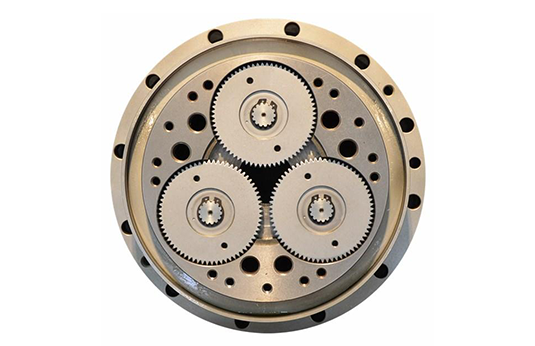
Classification and characteristics of reducers
Planetary reducer: mainly composed of planetary gears, sun gears, and internal gear rings, with a compact structure and high transmission efficiency. The single-stage transmission efficiency can reach 97% -98%. It has high load-bearing capacity and strong impact resistance, with relatively low cost. However, the single-stage transmission ratio is usually around 3-10, which is relatively low. The multi-stage structure can lead to an increase in volume, limited output torque, and relatively lower transmission accuracy. It is suitable for the body rotation joints in robots that require low precision.
RV reducer: composed of a two-stage reduction mechanism, with a large reduction ratio range and strong load-bearing capacity, good rigidity and overload impact resistance, high transmission accuracy and stability. But its quality and volume are relatively large, its lifespan is relatively short, the processing technology is complex, and the price is high. It is widely used in heavy-duty positions such as robot bases, arms, and shoulders.
Harmonic reducer: Based on the principle of elastic deformation of flexible wheels, it consists of three core components: wave generator, flexible wheel, and rigid wheel. It has the advantages of small size, light weight, high transmission accuracy, and large transmission ratio. Its torque density is significantly higher than traditional reducers, and it can transmit large torque in a compact volume. Moreover, there is almost no backlash and small side clearance during the transmission process. However, elliptical deformation of the flexible wheel every two rotations can easily lead to material fatigue damage, high power loss, and return error. It does not have self-locking function and also has certain requirements for heat dissipation. It is more suitable for use in lightly loaded parts such as robot arms, wrists, hands, as well as joints that require high-precision rotation such as shoulders, elbows, and waist.
Technical challenges and development trends of reducers
Technical challenges
Fatigue life and reliability of flexible wheels: Flexible wheels are prone to fatigue cracks under repeated elastic deformation, especially in high-frequency start stop and dynamic load scenarios of humanoid robots, where their lifespan significantly decreases.
Dynamic load and impact adaptability: The joints of humanoid robots need to withstand instantaneous impact loads, and the elastic deformation of harmonic reducers may cause transmission errors or an increase in instantaneous backlash, leading to unstable robot movements.
Lightweight and volume limitations: Humanoid robots are sensitive to joint volume and weight, but traditional harmonic reducers require a certain wall thickness to ensure flexible wheel strength, resulting in limited lightweight space.
development trend
Material innovation: If carbon fiber reinforced composite flexible wheels are used, it can reduce weight and improve fatigue life.
Structural design optimization: For example, ultra thin-walled cup-shaped flexible wheels are processed using wire cutting technology, combined with finite element simulation to optimize stress distribution and extend the service life of the flexible wheels; There is also a multi tooth difference design that can increase the number of meshing teeth, reduce single tooth loads, and improve transmission stability.
Intelligent integration: such as embedded sensors, integrated strain gauges, accelerometers, real-time monitoring of flexible wheel deformation and vibration, and fault prediction; Active compensation technology dynamically adjusts the torque of the wave generator through algorithms to offset the deformation error of the flexible wheel.
New transmission technology: such as hybrid reducers, using a harmonic+planetary gear composite structure, combining the high precision of harmonics with the high torque capacity of planetary gears, suitable for heavy-duty joints such as the waist of humanoid robots.
Related News