
Application of self-locking function of worm gear reducer
Release Time:
2024-09-27
It is particularly important to determine the self-locking performance of worm gear reducers when it is required. But in practical applications, self-locking is often difficult to determine. For example, in the process of designing a high-pressure vacuum switch tube exhaust station, its reducer is a worm gear mechanism (without a brake). When lifting the insulation cover, turn off the motor power and the mechanism usually locks immediately, preventing the insulation cover from lowering; However, during the descent movement, when the motor power is turned off, the mechanism can sometimes lock itself, sometimes it cannot lock itself, and even accelerate the descent, completely losing its self-locking ability. This phenomenon is mainly due to the influence of various factors in practical applications, such as manufacturing accuracy, lubrication conditions, load changes, etc.
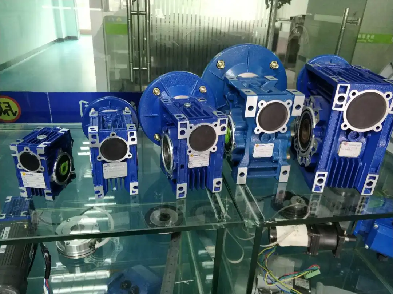
In the transmission mode of the reducer, worm gear transmission has characteristics that other gear transmissions do not have. Generally, the worm gear can rotate the worm gear relatively easily, but the worm gear is difficult to rotate. This is mainly due to the structural characteristics of the worm gear and the presence of certain friction during the transmission process.
The self-locking function of the worm gear transmission method is of great use in mechanical applications, such as in winches, conveying equipment, and other fields. However, it is precisely because of the friction transmission method of worm gear that its transmission efficiency is much lower compared to gear transmission.
Not all worm gear reducers have good self-locking function. The self-locking function of the worm gear requires a certain speed ratio condition to be achieved, which is closely related to the lead angle of the worm gear. Generally speaking, the self-locking function of worm gears with low speed ratios is relatively less ideal.
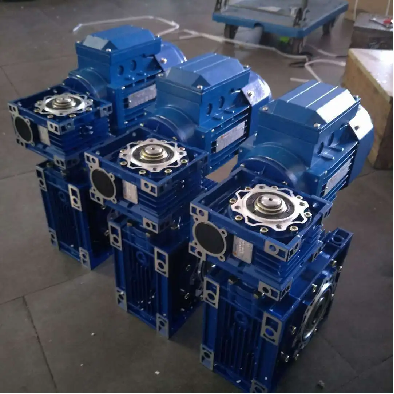
It is particularly important to determine the self-locking performance of worm gear reducers when it is required. But in practical applications, self-locking is often difficult to determine. For example, in the process of designing a high-pressure vacuum switch tube exhaust station, its reducer is a worm gear mechanism (without a brake). When lifting the insulation cover, turn off the motor power and the mechanism usually locks immediately, preventing the insulation cover from lowering; However, during the descent movement, when the motor power is turned off, the mechanism can sometimes lock itself, sometimes it cannot lock itself, and even accelerate the descent, completely losing its self-locking ability. This phenomenon is mainly due to the influence of various factors in practical applications, such as manufacturing accuracy, lubrication conditions, load changes, etc.
Related News