
Do you understand the working principle of the gearbox? 3 minutes to fully understand the power transmission logic
Release Time:
2025-07-16
Have you ever wondered why a small motor can drive a thousand pound equipment to run smoothly in a steel roaring factory, on a precision automated production line, and even in everyday cars and elevators? Why can a high-speed rotating shaft ultimately output slow yet powerful force? The answer is often hidden in those inconspicuous "iron boxes" - gearboxes!
Do you understand the working principle of the gearbox? 3 minutes to fully understand the power transmission logic
Have you ever wondered why a small motor can drive a thousand pound equipment to run smoothly in a steel roaring factory, on a precision automated production line, and even in everyday cars and elevators? Why can a high-speed rotating shaft ultimately output slow yet powerful force? The answer is often hidden in those inconspicuous "iron boxes" - gearboxes!
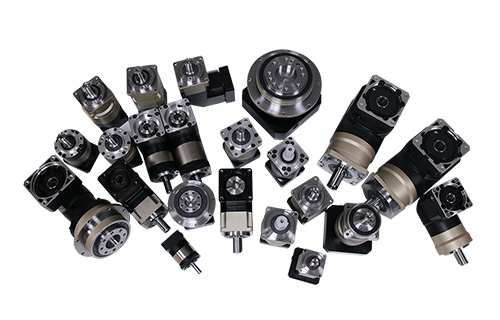
Don't be intimidated by the name, and don't be discouraged by the complex internal structure diagram! Today, without drawing or displaying charts, we will only use plain language and clear logical chains to take you for 3 minutes to thoroughly understand the core secret of power transmission in gearboxes. Even with zero foundation, you can easily get started!
Imagine you riding a bicycle and climbing a steep slope:
You press the foot pedal hard and quickly (equivalent to high-speed rotation of a small gear).
Drive the much larger gear on the rear wheel (equivalent to a large gear) through the chain.
What was the result? The rear wheels have turned much slower, but you feel that climbing hills has become exceptionally effortless!
The working principle of a gearbox is essentially a replica and upgrade of this process! It is a precise 'energy converter'.
Its core task is only one: to exchange "speed" for "power"!
The motor (or other prime mover) rotates at a high speed (such as 3000 revolutions per minute).
But this force (known as torque in professional terms) is relatively small, like a sprinter who runs fast but lacks strength. This high-speed rotating power enters the "gate" of the gearbox through the input shaft.
The core of the gearbox is one or more sets of interlocking gears. The common and basic way is for two gears, one large and one small, to mesh directly.
The input shaft is connected to a small gear (with fewer teeth). It drives the large gear (with many teeth) that meshes with it to rotate.
Magic happens here:
Sudden drop in rotational speed: Due to the larger size of the large gear (with more teeth), the small gear must rotate several times (such as 5 times) before the large gear can barely complete 1 turn! This resulted in a sharp decrease in output speed (such as from 3000 rpm to 600 rpm).
Torque surge: Although the speed has decreased, the force (torque) has increased significantly proportionally! What is the proportion of improvement? It's just the reduction ratio! Remember this golden formula:
Reduction ratio (i) ≈ number of teeth on the large gear (Z large)/number of teeth on the small gear (Z small)
For example, if a small gear has 20 teeth and a large gear has 100 teeth, then the reduction ratio i=100/20=5. This means:
The input shaft (small gear) rotates 5 turns → the output shaft (large gear) rotates only 1 turn → the speed drops to 1/5 of the input.
At the same time, the output torque (force) theoretically amplifies to 5 times the input! This is like five people pushing a heavy object at the same time that one person could not move. Although each person's pace (speed) slows down, the combined force (torque) greatly increases!
Related News