
The benefits of using a deceleration motor for motors
Release Time:
2025-07-14
A reduction motor (gearbox) is a specialized device used to reduce speed and increase output torque. Gearboxes are an important component of mechanical transmission systems. Currently, many applications have gearboxes, such as transportation, construction, and machining. So, what are the benefits of using a reduction motor (gearbox)?
The benefits of using a deceleration motor for motors
A reduction motor (gearbox) is a specialized device used to reduce speed and increase output torque. Gearboxes are an important component of mechanical transmission systems. Currently, many applications have gearboxes, such as transportation, construction, and machining. So, what are the benefits of using a reduction motor (gearbox)?
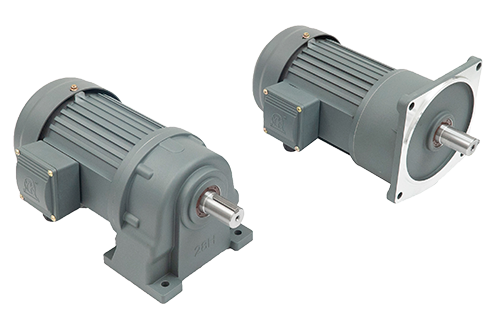
The reduction motor (gearbox) can effectively protect the electric motor. In operation, the torque borne by the gearbox is greater than that of the motor, and when overloaded, simply divide the overload by the gear ratio to transmit it to the motor.
To save costs, if the motor is directly subjected to torque, it will be damaged when overloaded. Conversely, if there is a reducer in front of the motor, simply replacing the reducer will result in lower costs.
The reducer effectively reduces the moment of inertia, allowing for timely control of start stop and speed changes. On the other hand, increasing torque through a reducer rather than increasing input power. Therefore, for the cost of increasing power, reducers are cheaper than electric motors.
Effective energy saving, using a deceleration motor can achieve the same output torque with less current.
Equipped with a reducer, it can effectively reduce the speed and increase the torque, and according to the output gear ratio of the motor. Effectively reduce the load inertia of the motor.
Increase output torque:
This is the core benefit. The reducer converts the high speed of the motor into low speed output through transmission mechanisms such as gears. At the same time, according to the principle of gear transmission (torque=power/speed, ignoring efficiency loss), the output torque will significantly increase.
Benefits: Enable the motor to drive heavier loads, overcome greater starting resistance or friction. For example, driving small cars, lifting heavy objects, stirring viscous liquids, and driving mechanical arm joints that require a large torque.
Reduce output speed:
Many mechanical devices do not require high speeds of several thousand or even tens of thousands of revolutions per minute from the motor itself, but rather require speeds of tens, hundreds, or even lower.
Benefit: The deceleration motor can directly provide precise and controllable low-speed output that meets equipment requirements, without the need for additional external deceleration mechanisms, simplifying the design. For example, conveyors, mixers, automatic doors, electric curtains, etc. all require low-speed operation.
Optimize the motor operating point to improve efficiency and performance:
The motor has a high efficiency when working near its rated speed and torque. If a regular motor is directly used to drive low-speed heavy loads, the motor may be forced to operate at low speed and high current (close to locked rotor), resulting in low efficiency, severe heat generation, and easy burning.
Benefit: The reducer allows the motor to operate in its efficient and high-speed range (close to rated speed), matching the low-speed high torque required by the load through the reducer. This way, the overall system efficiency is higher, the motor operates more stably, generates less heat, and has a longer lifespan.
Reduce motor size and cost:
In order to directly output high torque, it is necessary to choose motors with high power, large volume, and high cost. By increasing the torque through a reducer, one can choose motors with relatively lower power, more compact size, and lower cost.
Benefit: In space limited or cost sensitive applications, the reduction motor solution is usually better than directly using a high torque motor.
Improve motion control accuracy (for servo/stepper motors):
For applications that require precise positioning or speed control (such as robot joints, CNC machines), using reducers (especially high-precision planetary reducers or harmonic reducers) can:
Reduce the load inertia equivalent to the motor shaft: make the system respond faster and easier to control.
Improve resolution: For stepper motors, the reducer amplifies the angular displacement of each step, achieving finer position control.
Improve rigidity: reduce transmission clearance, make the system more responsive to load changes, and achieve more accurate positioning.
Improving torque control accuracy: Higher output torque means smaller relative torque fluctuations.
Provide overload protection (to a certain extent):
The gears of the reducer may be damaged before the motor in case of end overload (such as tooth breakage), which can sometimes serve as a mechanical safety to protect the more expensive motor body from burning out (but this is not the design purpose, overload protection should mainly rely on electrical protection devices).
In summary, the main benefits of a reduction motor are:
Using small power, high-speed motors to achieve low-speed, high torque output through reducers.
Efficient matching: allowing the motor to operate in the high-efficiency zone, improving overall system efficiency, reliability, and lifespan.
Space and cost savings: Compared to directly using high torque motors, the usual solution is more compact and economical.
Improved control performance: For precision applications, it can significantly improve motion control accuracy and response speed.
Therefore, in situations where low speed, high torque, precise control, or optimized system efficiency are required, a reduction motor is almost an inevitable choice. Choosing the appropriate reduction ratio and type of reducer is crucial for leveraging these advantages.
Related News