
Anatomy of the 'Magnetic Power Heart' of Permanent Magnet Synchronous Motor: Core Technology Analysis of Rotor Design
Release Time:
2025-07-10
As the core of efficient power source, the performance, reliability, and cost of permanent magnet synchronous motor (PMSM) are largely determined by the design of the rotor. The rotor, as a key component that carries permanent magnets and achieves electromechanical energy conversion, faces multiple challenges in its structural design, including electromagnetic performance, mechanical strength, thermal management, and manufacturing costs. This article will focus on the core technology of rotor design and conduct in-depth analysis based on engineering practice.
Anatomy of the 'Magnetic Power Heart' of Permanent Magnet Synchronous Motor: Core Technology Analysis of Rotor Design
As the core of efficient power source, the performance, reliability, and cost of permanent magnet synchronous motor (PMSM) are largely determined by the design of the rotor. The rotor, as a key component that carries permanent magnets and achieves electromechanical energy conversion, faces multiple challenges in its structural design, including electromagnetic performance, mechanical strength, thermal management, and manufacturing costs. This article will focus on the core technology of rotor design and conduct in-depth analysis based on engineering practice.
1、 Permanent magnet layout: structural cornerstone
The core of the rotor lies in the installation method of the permanent magnet, which directly determines the basic electromagnetic characteristics and mechanical strength of the motor. There are mainly three basic forms:
1. Surface protruding type: The permanent magnet is directly attached to the circumferential surface of the rotor core, with a relatively simple structure and a good waveform of the air gap magnetic field. However, the permanent magnet is completely exposed to centrifugal force, which is the main bottleneck for high-speed operation and must rely on high-strength protective measures (such as sheaths) for fixation.
2. Surface embedding: The permanent magnet is embedded in the slot on the surface of the rotor core, and the magnetic surface is relatively flat. Compared to the protruding type, the iron core provides some lateral support for the permanent magnet, enhancing its ability to resist centrifugal force, while allowing for a certain degree of convexity design, which is beneficial for weak magnetic expansion.
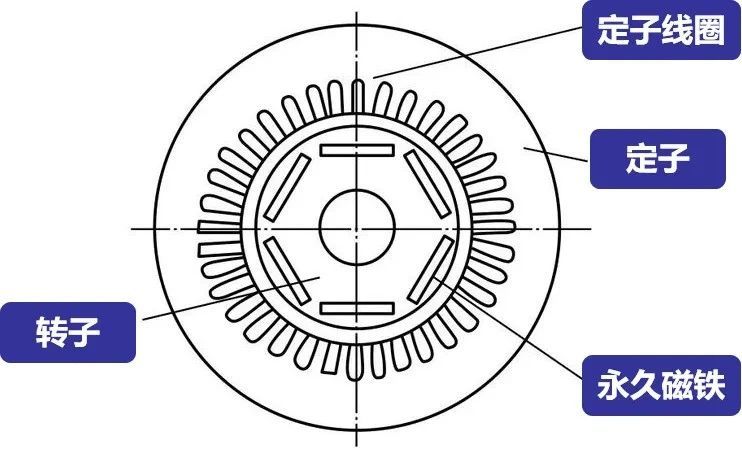
3. Embedded (built-in): This is the mainstream form of new energy vehicle drive motors. The permanent magnet is fully embedded in the pre opened slot inside the rotor core. The iron core provides natural and powerful mechanical protection for permanent magnets, enabling them to withstand high centrifugal forces and is the preferred choice for achieving high-speed operation. Its major advantage lies in the flexibility of design: it can design multiple magnetic barrier shapes (such as V-shaped, single shaped, double V-shaped, etc.) to form high convexity, significantly improve the magnetic reluctance torque component, achieve high power density and wide constant power speed regulation range (strong weak magnetic ability). The combination design of multi-layer permanent magnets can also optimize the waveform of the air gap magnetic field and reduce torque ripple. Of course, its structure is more complex, the manufacturing process requires high standards, and precise management of magnetic leakage (especially the saturation problem of the magnetic bridge) is necessary.
Core Trends and Persistent Challenges
The rotor design technology continues to evolve. Multi objective collaborative optimization (electromagnetic, mechanical, thermal, NVH, cost) has become mainstream with the help of AI algorithms. Advanced manufacturing processes, such as additive manufacturing for complex cooling structures and high-precision assembly, continuously break through structural limitations. New materials (higher temperature resistance/coercivity permanent magnets, low loss high-strength silicon steel, low-cost high-performance composite materials) are the key to performance improvement. The ultra-high speed design for applications such as fuel cell air compressors and high-speed energy storage poses more stringent challenges to rotor dynamics, strength, and loss control.
The rotor design of permanent magnet synchronous motor is a systematic engineering that integrates electromagnetic, structural, material, thermal, and process aspects. From the selection of basic permanent magnet layout, to the structural reinforcement and sheath technology to cope with high-speed centrifugal force, to the high convexity, lightweight and wrong design to improve efficiency, speed expansion capability and NVH performance, each core technology profoundly affects the final performance of the motor. Deeply understanding and mastering these core technologies is the key to developing high-performance, high reliability, and adaptable permanent magnet synchronous motors for diverse application needs.
Related News