
Revealing the difference between cycloidal pinwheel and involute gear
Release Time:
2024-09-26
In summary, involute gears have been widely used in industrial production due to their advantages of smooth transmission, good separability of center distance, and relatively easy machining. Cycloid gears, on the other hand, have important applications in specific fields such as precision machinery and harsh environments due to their unique tooth profile and wear resistance.
In the precision transmission industry, there are certain differences between cycloidal pinwheels and involute gears in terms of tooth surface formation principles, transmission characteristics, and application fields. The main differences are as follows. We have sorted out some of them. If there are any discrepancies, please feel free to leave a message to point them out.
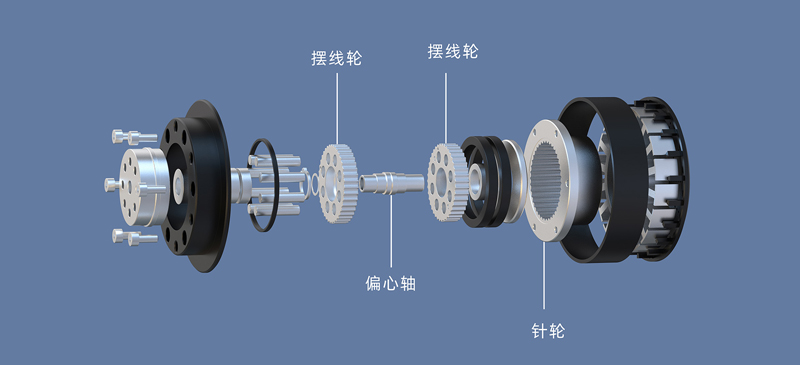
Firstly, the principle of tooth surface formation is that involute is a special case of cycloid. When the diameter of the external pendulum circle is infinite, cycloid becomes a straight line, thus forming involute. The tooth profile of involute gears is usually composed of a section of involute and a section of tooth root transition curve, while the tooth profile of cycloidal gears is composed of an external cycloid, an internal cycloid, and a section of tooth root transition curve.
Secondly, in terms of transmission characteristics, the meshing line of involute gears is a straight line, and the direction of force remains unchanged during transmission, resulting in better transmission stability. The meshing line of cycloidal gears consists of two circular arcs, and the direction of force transmission changes, resulting in less smooth transmission compared to involute gears.
There is also center distance sensitivity. Cycloid gears are very sensitive to center distance and do not have the characteristic of separable center distance in involute gear transmission. This means that the center distance of the cycloidal gear must be precise, otherwise it will affect its normal meshing.
There is a significant difference in wear resistance performance. Cycloid gears have convex (epitrochoid) and concave (epitrochoid) surfaces in contact during meshing. Usually, their tooth surfaces have a larger comprehensive curvature radius. According to Hertz stress theory, the surface contact stress is smaller than the contact stress generated by the meshing of the convex and convex surfaces of involute gears. Therefore, in the harsh working environment of open transmission without lubrication, the tooth surface of cycloidal gears is more wear-resistant than that of involute gears.
However, the manufacturing difficulty is also one of the major differences. The cutting tools for cycloidal gears are more complex compared to involute gears, and the manufacturing process is more difficult.
Finally, in terms of application fields, cycloidal gears are commonly used in precision machinery such as clock technology and planetary transmission, while involute gears are widely used in engineering machinery manufacturing.
In summary, involute gears have been widely used in industrial production due to their advantages of smooth transmission, good separability of center distance, and relatively easy machining. Cycloid gears, on the other hand, have important applications in specific fields such as precision machinery and harsh environments due to their unique tooth profile and wear resistance.
Related News