
Analysis of Characteristics and Applicable Scenarios of Various Gearboxes
Release Time:
2025-07-03
As a key component in the power transmission system, the core function of the gearbox is to increase the output torque by reducing the input speed, thereby meeting the power parameter requirements of different equipment. Due to differences in structural design, different types of reducers have their own emphasis on performance and applicable scenarios. The following will provide a detailed introduction to the characteristics and application situations of several common reducers.
Analysis of Characteristics and Applicable Scenarios of Various Gearboxes
As a key component in the power transmission system, the core function of the gearbox is to increase the output torque by reducing the input speed, thereby meeting the power parameter requirements of different equipment. Due to differences in structural design, different types of reducers have their own emphasis on performance and applicable scenarios. The following will provide a detailed introduction to the characteristics and application situations of several common reducers.
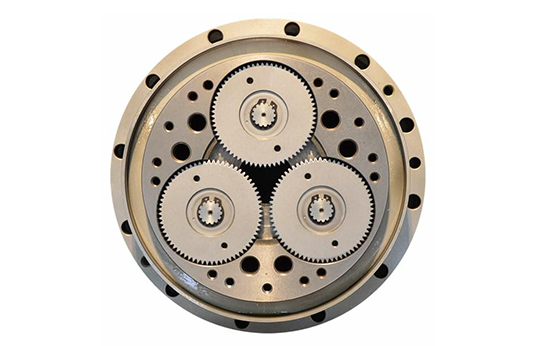
1、 Overview of Core Categories and Applicable Scenarios
If high-precision dynamic control is required, planetary reducers (with strong universality) or harmonic reducers (especially suitable for lightweight robots) are preferred choices.
When facing heavy loads and high rigidity requirements, such as the joint parts of industrial robots, RV reducers are the ideal choice.
For cost sensitive general scenarios, gear reducers (with excellent transmission efficiency) or worm gear reducers (when self-locking function is required) are more suitable.
2、 Harmonic reducer
The harmonic reducer consists of a fixed internal toothed rigid wheel, a flexible wheel that can undergo elastic deformation, and a wave generator that induces radial deformation of the flexible wheel. The transmission process utilizes the controllable elastic deformation wave of the flexible wheel to cause relative displacement between the teeth of the rigid wheel and the flexible wheel, thereby transmitting motion and power. When the wave generator rotates, the flexible wheel meshes with the rigid wheel in the long axis direction and is in a separated state in the short axis direction, completing the deceleration action through this continuous deformation. The single-stage reduction ratio is usually between 70 and 320, determined by the ratio of the number of rotations between the wave generator and the flexible wheel.
characteristic:
Compact structure, small size and light weight, suitable for installation in situations with limited space.
The transmission accuracy is high, and the error can be controlled within 1 arc minute, which can meet the requirements of high-precision motion control.
Weak load capacity, only suitable for light load scenarios such as the robot's forearm and wrist.
Due to the periodic deformation of the flexible wheel, its service life is relatively short, but domestic manufacturers have significantly improved its service life through technological improvements.
Application areas:
Humanoid robots, such as Tesla Optimus, require lightweight design with rotating joints.
Light load components such as the forearm, wrist, and hand of industrial robots.
Precision instruments with strict precision requirements such as medical equipment and semiconductor equipment
3、 RV gearbox
The structure of the RV reducer includes a front stage planetary gear set, a rear stage cycloidal pinwheel set, and a crankshaft connecting these two stages, adopting a two-stage reduction mode. The planetary gear is used for deceleration, and the input shaft drives the sun gear to rotate, which in turn drives the planetary gear to rotate around the inner ring gear; The second stage is the cycloidal pinwheel deceleration, which uses the eccentric motion of the crankshaft to mesh the cycloidal gear with the pinwheel, and uses the phase difference to offset radial runout, achieving secondary deceleration.
characteristic:
With high rigidity and high load capacity, the cycloidal pinwheel structure enables it to withstand heavy load impacts, making it suitable for high torque scenarios.
The transmission accuracy is relatively high, although slightly lower than that of harmonic reducers, the operational stability is stronger.
The structure is relatively complex, the manufacturing process requires high standards, and equipment such as gear grinders rely on imports, resulting in relatively high costs.
The design life can reach tens of thousands of hours, suitable for long-term continuous operation in industrial scenarios.
Application areas:
The large arms, shoulders, and other parts of multi joint robots in industrial robots that bear heavy loads.
The transmission system of heavy machinery such as cranes and construction machinery.
Industrial equipment with high load and continuous operation in automated production lines.
Related News