
The benefits of using a deceleration motor for motors
Release Time:
2025-06-25
A reduction motor (gearbox) is a specialized device used to reduce speed and increase output torque. Gearboxes are an important component of mechanical transmission systems. Currently, many applications have gearboxes, such as transportation, construction, and machining. So, what are the benefits of using a reduction motor (gearbox)?
The benefits of using a deceleration motor for motors
A reduction motor (gearbox) is a specialized device used to reduce speed and increase output torque. Gearboxes are an important component of mechanical transmission systems. Currently, many applications have gearboxes, such as transportation, construction, and machining. So, what are the benefits of using a reduction motor (gearbox)?
The reduction motor (gearbox) can effectively protect the electric motor. In operation, the torque borne by the gearbox is greater than that of the motor, and when overloaded, simply divide the overload by the gear ratio to transmit it to the motor.
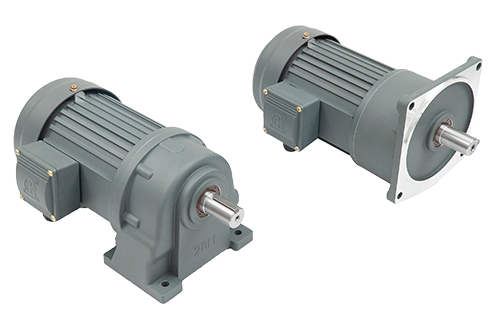
To save costs, if the motor is directly subjected to torque, it will be damaged when overloaded. Conversely, if there is a reducer in front of the motor, simply replacing the reducer will result in lower costs.
The reducer effectively reduces the moment of inertia, allowing for timely control of start stop and speed changes. On the other hand, increasing torque through a reducer rather than increasing input power. Therefore, for the cost of increasing power, reducers are cheaper than electric motors.
Effective energy saving, using a deceleration motor can achieve the same output torque with less current.
Equipped with a reducer, it can effectively reduce the speed and increase the torque, and according to the output gear ratio of the motor. Effectively reduce the load inertia of the motor.
There are many benefits to using a gearbox for motors, which is almost a common practice in modern industrial drive systems. The core benefits can be summarized as follows:
Amplify output torque:
This is the main and core benefit. The reducer amplifies the output torque of the motor proportionally through the reduction ratio of gears (or other transmission methods) (usually a ratio greater than 1, such as 10:1, 20:1, 100:1, etc.).
Formula: Output torque ≈ Motor torque × Reduction ratio × Efficiency
This means that you can choose motors with lower power, smaller size, and lower cost, and drive loads that require large starting or working torque by pairing them with reducers. Without a gearbox, directly driving loads that require high torque often requires expensive and bulky high-power motors.
Reduce output speed:
Motors, especially AC asynchronous motors and brushless DC motors, typically operate at higher rated speeds (such as 1000-3000 RPM or higher). However, many application devices such as conveyors, mixers, crane drums, walking wheels, machine tool workbenches, etc. require lower operating speeds (such as several to several hundred revolutions per minute).
The reducer reduces the high speed of the motor to the required working speed of the load according to the reduction ratio. Without a gearbox, direct connection can cause the load speed to be too high, making it unusable or even damaged.
Optimize the motor operating point to improve efficiency and performance:
The motor has a high efficiency when working near its rated speed and power. If the motor is directly used to drive low-speed loads, it will have to operate at a speed much lower than the rated speed, resulting in:
Significant decrease in efficiency: increased current, increased copper loss, severe heat generation, and energy waste.
Power factor deterioration: detrimental to the power grid or drive.
Difficulty in heat dissipation: The self cooling fan has poor performance at low speeds, and the motor is prone to overheating.
Insufficient torque output capability: In the low-speed range, the motor may not be able to provide sufficient torque (especially for asynchronous motors).
The reducer allows the motor to operate near its rated speed (high efficiency zone) while providing the required low speed and high torque to the load. This improves the overall efficiency of the system, reduces energy consumption, and optimizes the thermal management of the motor.
Reduce equivalent load inertia, improve dynamic response and control accuracy (especially for servo systems):
In applications that require fast start stop or precise position/speed control (such as robots, CNC machines), the rotational inertia of the load is a huge burden on the motor. The larger the load inertia, the more difficult it is to accelerate and decelerate, and the poorer the control accuracy and response speed.
The reducer (especially high reduction ratio) significantly reduces the equivalent load inertia converted to the motor shaft (equivalent inertia ≈ load inertia/(reduction ratio ²)).
This brings huge benefits:
Faster acceleration/deceleration capability: The motor can change the speed of the load faster.
Higher control bandwidth and accuracy: The system can respond to control instructions more accurately and quickly.
Reduced the requirement for peak torque of the motor: smaller motors can achieve the required dynamic performance.
Reduced the risk of system oscillation and instability.
Protect the motor and extend its lifespan:
Absorption of impact and vibration: The mechanical structure of the reducer (gears, bearings, etc.) can absorb some of the impact, vibration, and overload transmitted from the load side, playing a certain buffering role, reducing the direct transmission of these adverse factors to the precision motor (especially the motor shaft and bearings), thereby extending the service life of the motor.
Overload protection (some designs): Some gearbox designs (such as with friction plates or safety pins) can slip or disconnect in the event of severe overload, protecting the motor from burning out.
Match physical dimensions and installation:
The gearbox provides a more flexible installation method. It can change the direction of the output shaft (such as changing the direction by 90 degrees with a right angle reducer), or provide different installation flanges and output shaft forms, making the physical layout of the motor and load more convenient and compact.
In summary, the benefits of using a gearbox can be summarized as follows:
Using a small motor to drive a large load: achieved by amplifying torque.
Adapting high-speed motors to low-speed loads: achieved by reducing the speed.
Make the motor work more comfortably and efficiently: operate in the high-efficiency zone to reduce heat generation.
Make the system react faster and control more accurately: reduce equivalent inertia (especially crucial for servo applications).
Protect the motor from damage: buffer impact and overload.
Make mechanical design more flexible: adapt to spatial and directional requirements.
Related News