
How to achieve precise control of robot joints? The internal structure is so complex!
Release Time:
2025-06-20
The automation level of industrial robots nowadays is astonishing. 5-axis and 6-axis robots have so many joints and can achieve precise transmission of motion and commands. The various parts work closely together to complete complex tasks, which makes people curious about their transmission system and the structure of the joints?
How to achieve precise control of robot joints? The internal structure is so complex!
The automation level of industrial robots nowadays is astonishing. 5-axis and 6-axis robots have so many joints and can achieve precise transmission of motion and commands. The various parts work closely together to complete complex tasks, which makes people curious about their transmission system and the structure of the joints?
The deceleration transmission at the joints of robots requires a short transmission chain, small size, high power, light weight, and easy control. At the same time, for industrial robots with medium to high loads, sufficient stiffness, rotation accuracy, and motion accuracy stability are also required.
Robot joint deceleration transmission structure ↓↓↓
1. Core component: "Hardware foundation" of joints
Motor (power source)
Brushless DC motor (BLDC) or servo motor: provides high torque, low inertia, fast response power, and supports precise speed and position control.
Motor selection: It needs to match the load requirements (such as high torque motors commonly used in industrial robotic arms, and lightweight designs preferred for collaborative robots).
Reducer (torque amplification and precision improvement)
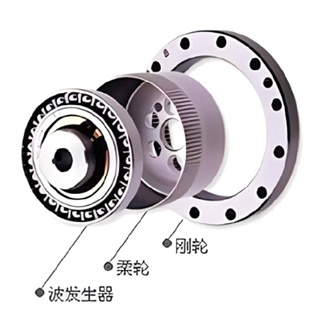
Harmonic reducer: transmits power through elastic deformation, with zero backlash (eliminating gear clearance), high reduction ratio (50:1~160:1), and accuracy up to 1 arcsecond (such as the Japanese Harmonic Drive).
Planetary reducer: With strong load-bearing capacity, it is used in high load scenarios (such as automotive manufacturing robots).
RV reducer: High rigidity and precision, commonly used in joint bases (such as ABB's IRB series).
High resolution encoder (position feedback)
Encoder: directly reads joint angles (without resetting), with a resolution of over 17 bits (130000 pulses per revolution).
Dual encoder design: motor end+output end dual feedback, eliminating errors caused by elastic deformation of the reducer (such as KUKA's RoboDrive).
Torque sensor (key to force control)
Directly measuring joint output torque to achieve force controlled compliance (such as collision prevention for surgical robots and collaborative robots).
2. The "brain" of control systems: algorithms and real-time performance
Closed loop control (PID and advanced algorithms)
PID control: Basic position/speed loop control, adjusting motor input through feedback.
Feedforward control: Predicting load inertia and friction to reduce tracking errors (such as high-speed picking and placing actions).
Adaptive control: Automatically adjust parameters to cope with load changes (such as handling objects of different weights).
Dynamic model compensation
Establish a robot model based on Newton Euler equations or Lagrangian dynamics, and calculate the compensation torque required for joints in real time (such as counteracting the influence of gravity on the robotic arm).
Resonance suppression algorithm
The reducer and structural elasticity are prone to vibration, and resonance needs to be suppressed through filter design (such as Notch filter) or state observer.
3. "Invisible technology" for precision assurance
temperature compensation
The thermal expansion of the steel wheel of the harmonic reducer can cause micrometer level deformation, which requires real-time calibration of temperature sensors (such as Fanuc's temperature control algorithm).
Friction compensation
Use Stribeck model or LuGre model to compensate for nonlinear friction, especially to avoid the phenomenon of "crawling" during low-speed motion.
Elastic deformation compensation
Pre calibrate structural deformation through finite element analysis (FEA) and perform reverse correction in control algorithms (such as aerospace robotic arms).
Related News