
He wanted to compromise and enter the motor, but 90% of people got it wrong
Release Time:
2025-06-17
To understand the "subdivision" of stepper motor drivers, it is necessary to first understand the concept of "step angle" of stepper motors!
He wanted to compromise and enter the motor, but 90% of people got it wrong
To understand the "subdivision" of stepper motor drivers, it is necessary to first understand the concept of "step angle" of stepper motors!
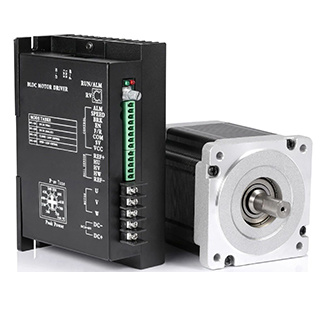
Step angle refers to the mechanical angle that the rotor rotates for a pulse signal without a reduction gear.
The step angle of the motor represents the angle of rotation of the motor for each pulse signal sent by the control system. Or, in other words, the angle at which the rotor rotates with each input pulse electrical signal is called the step angle.
It can also be described as follows: every time the stator control winding changes the power on mode, it is called one beat. The mechanical angle rotated by each rotor is called the step angle, usually represented by θ s. The common ones are 3 °/1.5 °, 1.5 °/0.75 °, and 3.6 °/1.8 °. For example, for a stepper motor (small motor) with a step angle of 1.8 degrees, the number of pulses required for one revolution is n=360/1.8=200 pulses.
The error of step angle will not accumulate for a long time and only corresponds to the number of input pulse signals. It can form a relatively simple and accurate open-loop control system, or a closed-loop system when higher accuracy is required.
For example, by explaining the step angle, everyone can have a clearer understanding of this concept:
If the value given by the motor is 7.5 °/15 ° (representing 7.5 ° for half step operation and 15 ° for full step operation), this step angle can be called the "inherent step angle of the motor", which may not be the true step angle of the motor during actual operation. The true step angle is related to the driver.
Subdivision of stepper motor drivers
Simply put, the subdivision number refers to a fraction of the true step angle of the motor during operation, which is the natural step angle (whole step). From the table below, it can be seen that when the driver operates in a 10 step subdivision state, its step angle is only one tenth of the 'inherent step angle of the motor'. In other words, when the driver operates in a non subdivision full step state, the control system rotates the motor 1.8 ° for every step pulse it sends; When using a subdivision driver to operate in a 10 subdivision state, the motor only rotates 0.18 °, which is the basic concept of subdivision. Do you understand? You can think it over and over again
A more accurate description of the subdivision characteristics of the drive is the number of operating beats, which refers to the number of pulses required for each pitch of the stepper motor during operation. A certain motor has 50 teeth. If the number of running beats is set to 160, the stepper motor needs a total of 8000 steps, which is 50 × 160, to rotate once; The corresponding step angle is 360 ° ÷ 8000=0.045 °. Please note that if the number of runs is set to 30, the corresponding subdivision score in the table above is 7.5, which is not an integer.
The subdivision function is entirely generated by the precise control of the motor's phase current by the driver, and is independent of the motor.
Related News