
Definition and Application of Joint Harmonic Reducer
Release Time:
2025-06-16
Definition of Joint Harmonic Reducer Joint harmonic reducer is a mechanical transmission device that relies on flexible components to generate elastic mechanical waves to transmit power and motion. The core working principle is to generate controllable elastic deformation of the flexible gear (flexible wheel) through the rotation of the harmonic generator, thereby meshing with the rigid gear (rigid wheel) to achieve high-precision deceleration transmission.
Definition and Application of Joint Harmonic Reducer
Definition of Joint Harmonic Reducer
Joint harmonic reducer is a mechanical transmission device that relies on flexible components to generate elastic mechanical waves to transmit power and motion. The core working principle is to generate controllable elastic deformation of the flexible gear (flexible wheel) through the rotation of the harmonic generator, thereby meshing with the rigid gear (rigid wheel) to achieve high-precision deceleration transmission.
The gearbox is mainly composed of three basic components:
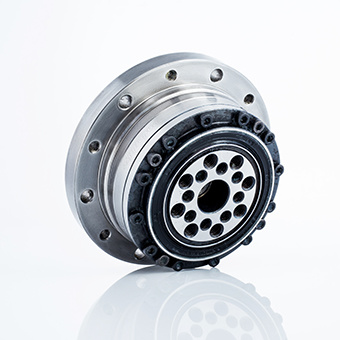
Harmonic generator: usually an elliptical structure that drives the flexible wheel to produce deformation.
Flexible wheel: thin-walled cylindrical shape, capable of elastic deformation, with an internal gear ring meshing with a rigid wheel.
Rigid wheel: a fixed or rotating rigid gear with an outer ring gear that matches a flexible wheel.
Application fields of joint harmonic reducer
Joint harmonic reducers are widely used in the following scenarios due to their high precision, high transmission ratio, small size, and light weight
1、 In the field of industrial robots
Joint drive: As the core transmission component of robot joints, such as the shoulder, elbow, and wrist joints of multi axis industrial robots and collaborative robots (cobots), it achieves precise angle control and motion trajectory planning.
Advantages: Small transmission clearance (close to zero backlash), fast response speed, able to meet the requirements of high-speed and repetitive positioning accuracy (up to ± 0.01mm) of robots.
2、 Aerospace and Defense
Precision instrument transmission: used for pitch and azimuth adjustment of satellite antennas, aiming mechanism of missile guidance heads, focusing system of aerial cameras, etc.
Features: It can still work stably in harsh environments such as vacuum and terminal temperature, and is lightweight and highly reliable.
3、 Medical devices
Surgical robots: such as the robotic arm joints of minimally invasive surgical robots, achieve millimeter level precision operations and reduce surgical trauma.
Rehabilitation equipment: Helps drive exoskeleton robots and prosthetic joints, providing smooth motion control and force feedback.
4、 Electronic and semiconductor equipment
Semiconductor manufacturing: used for precision platform movement of lithography machines and wafer inspection equipment, ensuring nanometer level positioning accuracy.
LCD panel production: Drive the substrate handling robotic arm to avoid panel scratches or positioning deviations caused by transmission errors.
5、 Optical and Astronomical Equipment
Telescope tracking system: drives the rotation of the telescope bracket, accurately follows the motion of celestial bodies, and ensures stable imaging.
Laser processing equipment: controls the deflection and focusing of the laser head to improve the accuracy of cutting or engraving.
6、 Other high-end fields
New energy equipment: such as the driving mechanism of solar tracking systems, which adjusts the orientation of photovoltaic panels in real time to maximize energy absorption.
High end CNC machine tools: used for deceleration transmission of precision spindles to improve the surface smoothness and dimensional accuracy of machined parts.
Related News