
Deep research on humanoid robots: harmonic reducer: differential gear transmission, continuous evolution
Release Time:
2025-06-12
In the wave of accelerating progress in the humanoid robot industry, harmonic reducers, as the core and key components, are becoming a key force in determining the pace of industrial advancement. Its technical barriers are high in tooth design, material preparation, and precision machining. Overseas manufacturers have long been at the forefront, and although breakthroughs have been made in tooth design and other aspects domestically, there is still a performance gap. The explosive growth in demand for humanoid robots drives the emergence of a turning point in the supply and demand of harmonic reducers in 2027, accelerating the restructuring of the competitive landscape and presenting both opportunities and challenges for domestic substitution.
Deep research on humanoid robots: harmonic reducer: differential gear transmission, continuous evolution
In the wave of accelerating progress in the humanoid robot industry, harmonic reducers, as the core and key components, are becoming a key force in determining the pace of industrial advancement. Its technical barriers are high in tooth design, material preparation, and precision machining. Overseas manufacturers have long been at the forefront, and although breakthroughs have been made in tooth design and other aspects domestically, there is still a performance gap. The explosive growth in demand for humanoid robots drives the emergence of a turning point in the supply and demand of harmonic reducers in 2027, accelerating the restructuring of the competitive landscape and presenting both opportunities and challenges for domestic substitution.
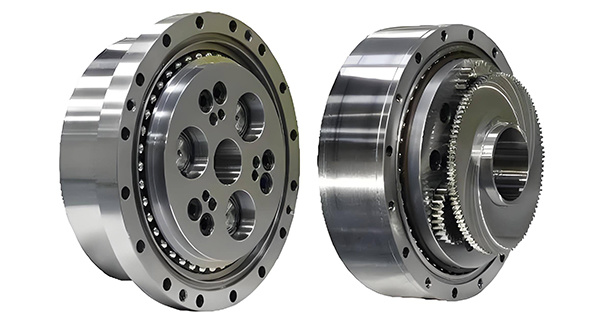
Design, materials, processes, and equipment create high barriers for harmonic reducers
Core component positioning
As the core of rotary actuators, reducers include harmonic, planetary, and RV reducers. Harmonic and planetary reducers are commonly used in humanoid robots. Harmonic reducers have small volume, light weight, and high precision, but their soft wheels have limited impact resistance and lifespan, and their cost is relatively high; The precision of planetary reducers is limited, and their load-bearing and impact resistance are superior to harmonics.
After optimization, RV reducers are expected to be used in humanoid joints in the future. They rely on cycloidal gears to mesh with needle teeth, providing high torque and impact resistance. Through optimization, the volume has been reduced and accuracy has been improved.
Structure and Transmission Principle
The structure of the harmonic reducer is relatively simple, consisting of a flexible wheel, a rigid wheel, and a wave generator. The transmission is based on the staggered motion between the flexible wheel and the rigid wheel, and the core is the elastic deformation of the flexible wheel and the meshing of the gear. Common double wave transmission, such as when the rigid wheel has 200 teeth and the flexible wheel has 198 teeth, the motor drives the wave generator to rotate once, the flexible wheel rotates 2/200 turns, and the reverse displacement is 2 teeth, with a reduction ratio of 100.
Adjusting the number of flexible and rigid teeth can achieve different reduction ratios, with single transmission reaching 70-500, and some devices and multi-stage transmission having higher reduction ratios.
Working principle (core: elastic deformation and misalignment motion)
Assembly: The flexible wheel is usually installed inside the rigid wheel, and the wave generator is inserted into the inner hole of the flexible wheel.
Deformation: The elliptical wave generator forces the flexible wheel to deform, causing it to fully mesh with the rigid gear teeth at both ends of the long axis of the wave generator (peak) and completely disengage from the rigid gear teeth at both ends of the short axis (valley).
Wrong tooth meshing:
Due to the fact that the number of flexible teeth is less than the number of rigid teeth (usually 2 teeth less, i.e. N_r=N_f-2, where N_r is the number of flexible teeth and N_f is the number of rigid teeth), when the wave generator rotates, the meshing point between the flexible and rigid teeth will continuously move.
When the wave generator rotates once, the teeth in contact between the flexible wheel and the rigid wheel in the meshing area will move relative to each other (N_f - N_r) by an angle of two teeth.
Deceleration output:
If the rigid wheel is fixed, the input rotation of the wave generator:
The flexible wheel will rotate in the opposite direction to the wave generator.
Reduction ratio i=- N_r/(N_f - N_r)=- N_r/2 (negative sign indicates opposite direction).
If the flexible wheel is fixed, the input rotation of the wave generator:
The rigid wheel will rotate in the same direction as the wave generator.
Reduction ratio i=N_f/(N_f - N_r)=N_f/2.
These are two commonly used configurations. The reduction ratio is usually very large (commonly between 50:1 and 320:1).
Key features (advantages)
High precision: Multiple teeth mesh simultaneously (usually with 30% of teeth involved in meshing), significantly reducing the impact of manufacturing errors on individual teeth, resulting in high transmission accuracy.
Zero backlash/small backlash: The flexible wheel always maintains close contact with the rigid tooth under the action of pre tension, which can achieve theoretical zero backlash transmission. Even with small backlash, it is stable, which is crucial for the positioning accuracy of the robot.
High reduction ratio: A large reduction ratio (usually 50:1 to 320:1) can be achieved in a single-stage transmission, with a compact structure.
High torque density: capable of transmitting significant torque per unit volume/weight.
Compact structure and light weight: with a small number of parts (three basic components) and small axial dimensions.
High transmission efficiency: Compared to its high reduction ratio, the efficiency can usually reach 80% -90%.
Smooth movement and low noise: Multi tooth meshing makes the transmission smoother and the noise lower.
Related News