
What is the difference between servo motors, variable frequency motors, and ordinary motors?
Release Time:
2025-06-11
But the servo controls both the current loop, speed loop, and position loop by closing them, which is a big difference. In addition, the structure of servo motors is different from that of ordinary motors, and they need to meet the requirements of fast response and accurate positioning.
What is the difference between servo motors, variable frequency motors, and ordinary motors?
The basic concept of servo is accurate, precise, and fast positioning. Frequency conversion is a necessary internal component of servo control, and it also exists in servo drives (requiring stepless speed regulation).
But the servo controls both the current loop, speed loop, and position loop by closing them, which is a big difference. In addition, the structure of servo motors is different from that of ordinary motors, and they need to meet the requirements of fast response and accurate positioning.
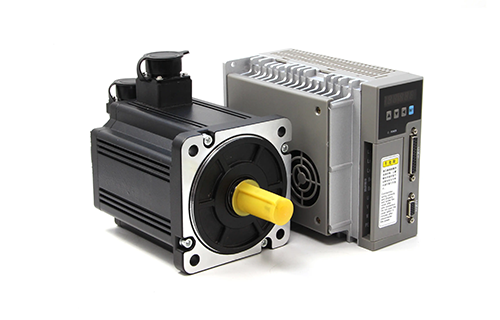
The AC servo motors currently in circulation on the market are mostly permanent magnet synchronous AC servo motors, but due to process limitations, it is difficult to achieve high power. Synchronous servo motors with a power output of more than ten KW are extremely expensive. Therefore, AC asynchronous servo motors are often used when field applications permit. In this case, many drives are high-end frequency converters with encoder feedback closed-loop control.
The so-called servo is to meet the requirements of accurate, precise, and fast positioning, as long as it meets the requirements, there is no dispute over servo frequency conversion.
1、 The commonality between the two
The technology of AC servo itself draws on and applies the technology of frequency conversion. Based on the servo control of DC motors, it imitates the control mode of DC motors through the PWM method of frequency conversion, which means that AC servo motors must have a frequency conversion link.
Frequency conversion is the process of rectifying AC power at frequencies of 50 and 60 Hz into DC power, and then using various controllable transistors (IGBT, IGCT, etc.) through carrier frequency and PWM regulation to invert it into a frequency adjustable waveform similar to sine and cosine pulsating electricity. Due to the adjustable frequency, the speed of the AC motor can be adjusted (n=60f/p, n speed, f frequency, p logarithm).
2、 Talk about frequency converters
A simple frequency converter can only adjust the speed of an AC motor, which can be open-loop or closed-loop depending on the control method and frequency converter. This is the traditional V/F control method.
Nowadays, many frequency converters have established mathematical models to convert the stator magnetic field UVW3 of AC motors into two components of current that can control motor speed and torque. Most famous brands of frequency converters that can perform torque control now use this method to control torque. The output of each phase of UVW needs to be equipped with a Hall effect current detection device, and after sampling feedback, it forms a PID regulation of the closed-loop negative feedback current loop; ABB's variable frequency also proposes a direct torque control technology that is different from this method. Please refer to relevant materials for details.
This can control both the speed and torque of the motor, and the speed control accuracy is better than v/f control. The encoder feedback can be added or not, and the control accuracy and response characteristics are much better when added.
Related News