
Comparison and Selection Introduction of Stepper and Servo Motor Characteristics Motor Classification and Technological Evolution
Release Time:
2025-05-24
The classification system of stepper motors is based on the phase number architecture, and currently the mainstream market is focused on two-phase and five phase models. The traditional two camera model can achieve a subdivision of 400 steps per revolution, while the five camera model can achieve a subdivision accuracy of up to 1000 steps per revolution through multi-phase winding control. Compared to two-phase products, the five phase model performs better in dynamic response speed and torque fluctuation suppression, with an acceleration characteristic improvement of about 30% and a mechanical vibration amplitude reduction of over 20%.
Comparison and Selection Introduction of Stepper and Servo Motor Characteristics
Motor Classification and Technological Evolution
The classification system of stepper motors is based on the phase number architecture, and currently the mainstream market is focused on two-phase and five phase models. The traditional two camera model can achieve a subdivision of 400 steps per revolution, while the five camera model can achieve a subdivision accuracy of up to 1000 steps per revolution through multi-phase winding control. Compared to two-phase products, the five phase model performs better in dynamic response speed and torque fluctuation suppression, with an acceleration characteristic improvement of about 30% and a mechanical vibration amplitude reduction of over 20%.
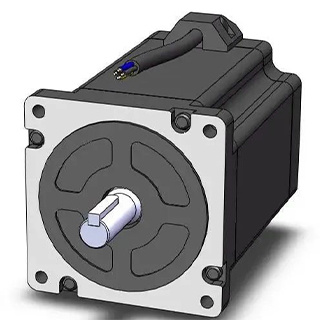
stepping motor
With the breakthrough of fully digital control technology, AC servo systems are gradually replacing traditional drive schemes. The current motion control system mainly uses two types of actuators: stepper motors and fully digital servo motors. Although both use pulse command control, there are significant differences in performance boundaries and application scenarios. The following text compares the performance differences between the two from multiple dimensions:
Comparison of core technical indicators
1. Control accuracy hierarchy
Stepper motor: The standard step angle for two-phase models is 1.8 ° (200 steps/revolution), while for five camera models it is refined to 0.36 ° (1000 steps/revolution). High end models such as slow wire dedicated motors achieve 0.09 ° subdivision, while three-phase hybrid models support eight step angle switching (adjustable from 0.036 ° to 1.8 °).
two-phase stepper motor
Servo system: Taking a certain series as an example, it is equipped with a 2500 line encoder and four fold frequency technology to achieve a positioning accuracy of 0.036 °/pulse; The 17 bit encoder model (131072 resolution) achieves a control accuracy of 9.89 arcseconds, 655 times higher than the stepping system.
servo motor
2. Torque speed characteristics
Stepper system: The output torque decays exponentially with increasing speed, and the effective working range under typical operating conditions is 300-600rpm. The torque loss rate in the high-speed zone exceeds 60%, limiting its application in high-speed precision situations.
Servo system: using permanent magnet synchronization technology, it maintains a constant torque output within the rated speed range (2000-3000rpm), and can still maintain over 90% torque capacity after entering the constant power zone.
3. Low frequency operating characteristics
Stepper system: prone to low-frequency resonance phenomenon, and the half frequency band (about 50-150Hz) of the no-load take-off frequency is prone to mechanical resonance. The solution includes subdivision drive modification (subdivision level ≥ 8) or installation of mechanical damping mechanism.
Servo system: integrates digital filtering and active noise reduction algorithms, compensates for mechanical rigidity defects in real time through FFT harmonic analysis.
4. Overload Capacity Comparison
Stepper system: It usually does not have overload capacity, and in order to meet the inertia torque of customer service, it is necessary to select a motor with a larger torque when selecting, which results in torque waste.
Servo system: With a typical overload factor of 300%, it can withstand 3 times the rated torque impact within 200ms and effectively cope with the starting inertia load.
5. Control loop design
Open loop architecture: The stepper system relies on feedforward compensation, and the positioning error compensation amount needs to be pre-set at 10-15%. Improper planning of acceleration and deceleration curves can easily lead to step loss (with a significant increase in risk when>2000rpm).
Closed loop architecture: The servo system uses an encoder for closed-loop feedback, and samples the feedback signal from the motor encoder through a driver. The internal structure consists of a position loop and a velocity loop, making it less prone to overshoot or step loss like stepper motors.
6. Dynamic response performance
Stepper motor: The typical acceleration time from 0 to 100 revolutions per minute is 200-400ms, and the acceleration time from rest to reaching the working speed is long.
Servo motor: Models of the same specifications achieve a 3ms level acceleration response, which can be almost negligible. It has good compatibility for control situations with fast start stop, which has a very important impact on mechanical equipment and automation rhythm.
Related News