
Knowledge related to servo motors
Release Time:
2025-05-22
A servo motor refers to an engine that controls the operation of mechanical components in a servo system, and is an indirect transmission device that supplements the motor.
Knowledge related to servo motors
What is a servo motor
A servo motor refers to an engine that controls the operation of mechanical components in a servo system, and is an indirect transmission device that supplements the motor.
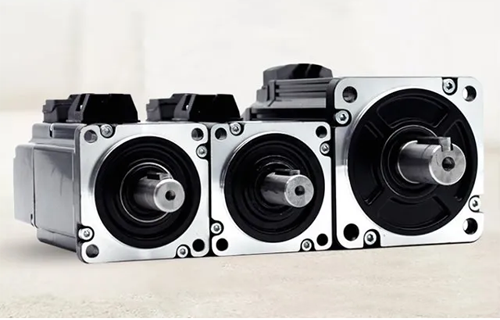
Servo motors can control speed and position accuracy very accurately, and can convert voltage signals into torque and speed to drive control objects. The rotor speed of a servo motor is controlled by input signals and can react quickly. In automatic control systems, it is used as an actuator and has characteristics such as small electromechanical time constant, high linearity, and starting voltage. It can convert the received electrical signal into angular displacement or angular velocity output on the motor shaft. It is divided into two categories: DC and AC servo motors. Its main feature is that when the signal voltage is zero, there is no self rotation phenomenon, and the speed decreases uniformly with the increase of torque.
Working principle of servo motor
1、 The structure of the stator of an AC servo motor is basically similar to that of a capacitor phase separated single-phase asynchronous motor The stator is equipped with two windings located 90 ° apart from each other, one of which is the excitation winding Rf, which is always connected to the AC voltage Uf; The other is to control winding L and connect the control signal voltage Uc. Therefore, AC servo motors are also known as two servo motors.
Servo mainly relies on pulses for positioning. Basically, it can be understood as follows: when a servo motor receives one pulse, it will rotate the corresponding angle of one pulse to achieve displacement. Because servo motors have the function of emitting pulses, every time they rotate an angle, they will emit a corresponding number of pulses. This forms a response or closed loop with the pulses received by the servo motor. In this way, the system will know how many pulses have been sent to the servo motor and how many pulses have been received back. In this way, the rotation of the motor can be accurately controlled to achieve precise positioning, which can reach 0.001mm.
Working principle and function of servo motor:
The function of a servo motor is to drive and control the object. The torque and speed of the controlled object are controlled by the signal voltage. When the magnitude and nature of the signal voltage change, the rotational speed and direction of the motor also change accordingly.
Classification of servo motors:
AC servo motor and DC servo motor.
Communication servo motor:
The principle is the same as that of a two-phase asynchronous motor, with two windings installed on the stator - the excitation winding and the control winding.
Related News