
Motor classification and working principle
Release Time:
2025-05-10
An electric motor is an electromagnetic mechanical device that converts electrical energy and mechanical energy into each other. Electric motors generally have two forms of application. It converts mechanical energy into electrical energy, which is called a generator. The second is to convert electrical energy into mechanical energy, which is called an electric motor. This article mainly discusses the classification and working principle of motors.
Motor classification and working principle
An electric motor is an electromagnetic mechanical device that converts electrical energy and mechanical energy into each other. Electric motors generally have two forms of application. It converts mechanical energy into electrical energy, which is called a generator. The second is to convert electrical energy into mechanical energy, which is called an electric motor. This article mainly discusses the classification and working principle of motors.
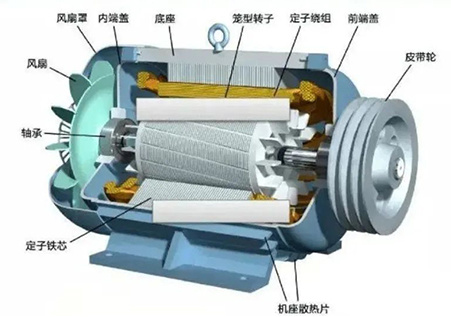
According to the working power supply, it can be divided into DC motors and AC motors.
DC motors: including brushed DC motors and brushless DC motors.
Brushed DC motor: can be divided into permanent magnet DC motor and electromagnetic DC motor
Brushless DC motor: using electronic commutator instead of mechanical commutator
Asynchronous motors: including induction motors and AC commutator motors
Induction motors: including single-phase induction motors, three-phase induction motors, and covered induction motors
AC commutator motor: including single-phase series excited motor, three-phase AC commutator motor, series excited AC commutator motor, parallel excited AC commutator motor, and compound excited AC commutator motor
Synchronous motors: including permanent magnet synchronous motors, reluctance synchronous motors, stepper synchronous motors, and brushless DC synchronous motors
Working principle of motor
To facilitate the subsequent explanation of motor principles, let's review the basic laws/regulations related to current, magnetic field, and force. Although there is a nostalgic feeling, if magnetic components are not frequently used, it is easy to forget these knowledge.
How does the motor rotate?
1) The motor rotates with the help of magnets and magnetic forces
Around a permanent magnet with a rotating axis, ① the rotating magnet (generates a rotating magnetic field), ② according to the principle of N and S attracting and repelling each other, ③ the magnet with a rotating axis will rotate.
This is the basic principle of motor rotation.
The current flowing through the wire generates a rotating magnetic field (magnetic force) around it, causing the magnet to rotate, which is actually the same action state.
In addition, by winding the wire into a coil shape, the magnetic force is synthesized to form a large magnetic flux (magnetic flux), producing N and S.
Inserting an iron core into a coil shaped wire makes it easier for magnetic lines to pass through, generating stronger magnetic force.
Related News