
Planetary reducer vs ordinary gear reducer
Release Time:
2025-05-08
In the field of industrial transmission, the competition between planetary reducers and ordinary gear reducers has never stopped - the former is known for high precision and high torque, while the latter is based on low cost and strong adaptability.
Planetary reducer vs ordinary gear reducer
In the field of industrial transmission, the competition between planetary reducers and ordinary gear reducers has never stopped - the former is known for high precision and high torque, while the latter is based on low cost and strong adaptability.
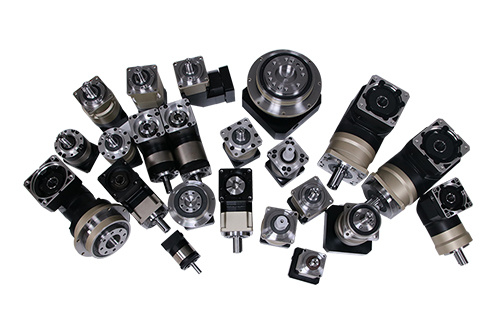
But who is more efficient? Who is more durable? This article reveals the answer for you through structural disassembly, performance testing, and application scenario comparison!
Structural Differences: Precise Collaboration of Planetary Systems vs. Individual Combat of Gear Sets
Planetary gearbox: Space grade precision transmission system
Core structure: Composed of a sun gear, planet gears, inner ring gear, and planet carrier, forming a concentric transmission structure similar to the solar system.
Power transmission: The input shaft drives the sun gear, which drives the planetary gears to both rotate and revolve. The power is output through the planetary carrier, achieving power splitting and multi tooth meshing, and evenly distributing torque.
Dynamic demonstration: planetary gears synchronously mesh, power is dispersed and transmitted, reducing single point wear.
2. Ordinary gear reducer: the "hardcore straight man" of traditional transmission
Core structure: Multiple sets of parallel axis gears (such as helical gears and bevel gears) transmit power through meshing, with a simple structure but occupying a large space.
Power transmission: Single stage gears mesh directly, and the load is concentrated on a few tooth surfaces, which can easily cause stress concentration and wear.
Dynamic comparison: The gear is subjected to single point force, and the transmission path is single.
Structural summary: Planetary reducers disperse loads through multi tooth synchronous meshing, while ordinary gear reducers rely on single-stage gear hard support. The former has more advantages in rigidity and lifespan
Efficiency, accuracy, and lifespan comparison
Transmission efficiency: The planetary gearbox crushes 90% of the ordinary gear with 97% of its speed
Planetary reducer: Multi tooth meshing reduces energy loss, with a single-stage efficiency of up to 97% -98%, especially suitable for high-frequency precision transmission.
Ordinary gear reducer: single-stage efficiency is about 90% -96%, and after multi-stage transmission, the efficiency further decreases and heat accumulation becomes more obvious.
Case: Nidec planetary gearbox in CNC machine tools reduces heat generation due to high efficiency and extends equipment life by 30%.
2. Transmission accuracy: The backlash of the planetary reducer is as low as 1 arc minute, with an error of only the thickness of a coin
Planetary reducer: using helical gear grinding technology, the backlash can be compressed to 1 arc minute (1/60 degree), and the repeated positioning accuracy reaches 0.01mm, meeting the nanoscale control requirements of semiconductor equipment.
Ordinary gear reducer: The backlash is usually 5-10 arc minutes, which is only suitable for scenarios with low precision requirements (such as conveyor belts).
3. Lifespan and Durability: The planetary gearbox has a lifespan of over 20000 hours, and its maintenance free design is more worry free
Planetary reducer: The gears are made of carburized and quenched alloy steel, with a wear resistance life of up to 20000 hours, and some models are free of lubrication for life.
Ordinary gear reducers: By relying on regular replacement of lubricating oil, their lifespan can be reduced by 50% in high temperature or dusty environments.
Actual test data: In the high-temperature environment of the metallurgical industry, the failure rate of planetary reducers is 60% lower than that of gear reducers
Related News