
What is a gearbox? After reading this article, I am no longer afraid of pitfalls in selection!
Release Time:
2025-05-06
A reducer, in other words, is a device that reduces speed and increases torque. It reduces the high speed of the motor and increases the output torque through internal transmission components such as gears and worms, allowing the equipment to operate more efficiently. Just like when we ride a bicycle and shift to low gear, although the pedaling speed slows down, climbing the slope becomes more exciting. The principle of the gearbox is somewhat similar to this.
What is a gearbox? After reading this article, I am no longer afraid of pitfalls in selection!
A reducer, in other words, is a device that reduces speed and increases torque. It reduces the high speed of the motor and increases the output torque through internal transmission components such as gears and worms, allowing the equipment to operate more efficiently. Just like when we ride a bicycle and shift to low gear, although the pedaling speed slows down, climbing the slope becomes more exciting. The principle of the gearbox is somewhat similar to this.
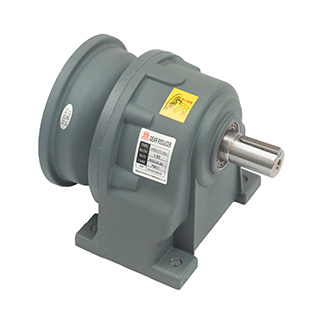
What does a decelerator look like
1. Transmission parts: Gears, worms, etc. are the core components of the reducer. They mesh with each other, transmitting power and motion, just like athletes in relay races, passing the baton of "power" down one after another.
2. Shaft: The shaft plays an important role in supporting and transmitting power. It is like a "backbone" that allows the transmission components to rotate stably, transmitting power from the input end to the output end.
3. Bearings: Although bearings are small, their role should not be underestimated. It can reduce the friction between the shaft and the shaft hole, making the shaft rotate more smoothly, just like putting a pair of "ice skates" on the shaft.
4. Box: The box is the "home" of the gearbox, which not only protects the internal parts, but also provides stable support and correct relative position for them. Just like the house we live in, although the structure inside cannot be seen, it firmly guards everything.
For example, if the servo motor rotates at 3000rpm, but the robotic arm joint only needs 30rpm, the reducer can reduce the speed by 100 times and amplify the output torque by 100 times.
Choose harmonics for accuracy, worm gears for affordability, cycloids for durability, and planets for comprehensive performance!
1. Gear reducer
This is a common method of transmitting power through the meshing of large and small gears. It has high efficiency, compact structure, and is suitable for use in various general-purpose devices.
Advantages: High transmission efficiency (over 90%), long lifespan, suitable for high-speed scenarios, such as machine tool spindle transmission.
Disadvantages: The noise is relatively high, and high-precision gears (such as gear grinding technology) need to be selected for precision machining equipment.
Typical scenarios: Industrial robot arms, automated production line conveyors.
2. Worm gear reducer
It has a compact structure, high transmission ratio, and low noise.
Advantages: Large transmission ratio (up to 80:1 per stage), compact structure, and built-in self-locking function (the elevator will not slide during power outages).
Disadvantages: Low efficiency (60% -70%), severe heat generation, requiring regular oil changes.
Typical scenario: Suitable for applications with high noise requirements, such as elevators, cranes, elevator traction machines, small cranes, and automated gates.
3. Planetary gear reducer
It has high efficiency, high precision, and strong load-bearing capacity.
Advantages: Small size, high transmission accuracy (back clearance can be controlled within 5 arc minutes), strong impact resistance.
Disadvantages: Expensive price (3-5 times that of ordinary gear reducers) and difficult maintenance.
Typical scenarios: Commonly used for high-precision and high torque equipment, such as unmanned aerial vehicle gimbal, semiconductor wafer cutting machine, and CNC machine tools.
Related News