
About Dust Explosion proof Motors
Release Time:
2025-05-05
Dust explosion-proof motors are commonly used in factories and enterprises with high levels of dust, which can prevent combustible dust from being ignited. Many textile manufacturers equip their operating equipment with dust explosion-proof motors to organize the flammable and explosive substances generated by dust. So what are the precautions for dust explosion-proof motors? How to understand dust explosion-proof motors?
About Dust Explosion proof Motors
Dust explosion-proof motors are commonly used in factories and enterprises with high levels of dust, which can prevent combustible dust from being ignited. Many textile manufacturers equip their operating equipment with dust explosion-proof motors to organize the flammable and explosive substances generated by dust. So what are the precautions for dust explosion-proof motors? How to understand dust explosion-proof motors?
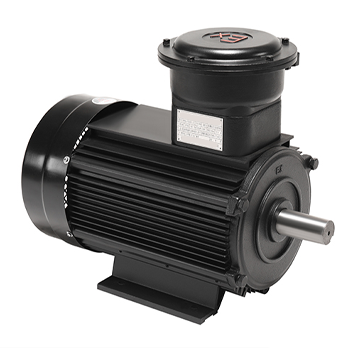
Dust explosion-proof motor
The motor refers to a motor whose casing is designed and manufactured according to specified conditions, which can prevent dust from entering the motor casing or, although it cannot completely prevent dust from entering, its entry amount does not hinder the safe operation of the motor, and the accumulation of internal dust is not likely to cause ignition hazards. It also does not cause explosive powder and dust mixture explosions in the surrounding area when used.
(1) The shell has high sealing performance to reduce or prevent dust from entering the shell, and even if it does, its entry amount will not pose a risk of ignition.
(2) Control the high surface temperature of the casing to not exceed the specified temperature range. Used on mechanized equipment in the national grain reserve warehouse.
Dust explosion-proof motor
Sealing structure characteristics
Sealed type refers to the connection between the internal and external components of an explosion-proof motor, which achieves dust-proof effect by adding sealing gaskets. The sealing gasket must be made of asbestos board, rubber board or other durable high-quality materials, and should be suitable for the load conditions and expected working life temperature of the electrical equipment, otherwise it will affect the explosion-proof performance of the motor.
The sealing parts of sealed dust explosion-proof motors mainly refer to the joints between the motor base and the end cover, the joints between the end cover and the outer cover, the joints between the base and the junction box, and the joints between the box base and the box cover.
The sealing between the machine base and the end cover also requires high sealing requirements due to the circumference of the joint surface. In order to achieve sealing performance, the sealing gasket must have a certain degree of elasticity. In order to maintain stable bearing distance of the motor, there must be a positioning structure between the machine base and the end cover, and the positioning cannot be determined by the strength of the sealing gasket. When the connecting bolts between the end cover and the machine base are tightened, the sealing gasket is compressed and becomes thinner. The end cover will move inward, and the entire bearing chamber will also move accordingly. Mild cases may reduce the axial clearance reserved in the design and the axial clearance of the bearing. In severe cases, it may cause the bearing to jam. Even if it does not jam, when the explosion-proof motor runs, it will inevitably cause high bearing noise, high bearing temperature, and short service life.
Classification of Dust Explosion Hazardous Areas
Before understanding dust-proof and explosion-proof motors, first understand how dust explosion hazardous areas are classified. Dust explosion hazardous areas are divided into two zones based on the frequency and duration of explosive or combustible dust environments.
Zone 10: An area where dust clouds or dust layers that may occur or mix with air during normal processing, handling, or cleaning can reach explosive concentrations.
Zone 11: An area not designated as Zone 10, but where dust clouds appear under abnormal conditions and can reach explosive concentrations when mixed with air.
1. Explosion proof type: Ex dI Mb suitable for coal mines
2. Explosion proof type: Ex d IIB T4 Gb. Suitable for factory locations with combustible gases (propane ethylene).
3. Explosion proof type: Ex d IIC T4 Gb is suitable for places with combustible gases in factories (hydrogen, propane, ethylene).
4. Explosion proof type: Ex tD B21 T135 ° C is suitable for factory areas with combustible dust and combustible flying fluff (such as feed, textile, flour, cement, and other places where dust is generated).
5. Explosion proof type: Ex d IIC T4 Gb/Ex td B21 T135 ° C is suitable for factories with flammable gas areas, as well as places with flammable dust and flammable flying fluff (such as feed, textiles, flour, cement and other places that can generate dust).
Related News