
Science popularization of reducers that high school students can also understand
Release Time:
2025-04-23
Imagine that when you ride a bicycle and encounter an uphill slope, you will switch the small gear to save effort - this is the principle of "deceleration"
Science popularization of reducers that high school students can also understand
1、 A brief history of the development of reducers: from steam engines to robots
Imagine that when you ride a bicycle and encounter an uphill slope, you will switch the small gear to save effort - this is the principle of "deceleration". In the early stages of the Industrial Revolution, steam engines needed to "slow down" the high-speed rotating power to a speed suitable for mechanical work, and early reducers were like the chains and gears of bicycles. With the development of industry, engineers have invented various reducers, such as using helical gears to reduce noise (similar to car transmissions), using worm gears to achieve large reduction ratios (like smooth lifting in elevators), and precision reducers for robot joints (such as harmonic reducers). Each generation of reducers is born to solve the problem of "quieter, more labor-saving, and more precise".
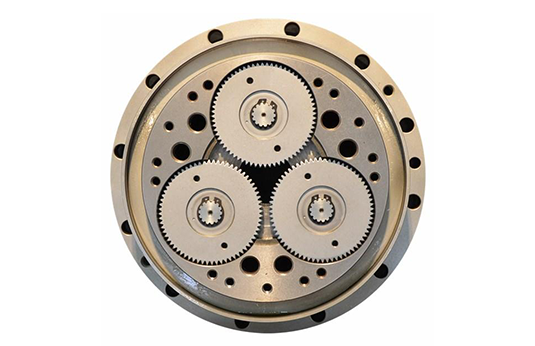
2、 The "martial arts secrets" and "life gate" of RV reducer and harmonic reducer
1. Harmonic reducer
Life case: The joint of a robotic arm rotates flexibly like a human wrist; The robot twisting yangko performed on the Spring Festival Gala has joints that rotate flexibly like humans
advantage:
High precision: repeated positioning accuracy of 0.001 degrees (equivalent to 1/600 of a clock's second hand)
Small size: A palm sized model can output 200N · m torque
Zero backlash: The transmission clearance is 10 times thinner than a human hair
Disadvantage: The flexible wheel is prone to fatigue and fracture.
Easy to generate heat: Continuous operation requires the use of heat sinks
Short lifespan: about one-third of the service life of RV reducers
Not resistant to impact: Falling may cause permanent deformation of the flexible wheel
Industry:
Industrial robots: lightweight collaborative robots, precision assembly
Machine tools and precision machining: precision grinding machines, optical measuring equipment
Semiconductor and Electronic Manufacturing: Wafer Handling Robotic Arm, Photolithography Alignment System
Medical devices: surgical robot joints, imaging equipment rotating mechanisms
Aerospace: Satellite antenna deployment mechanism, drone servo control
New energy vehicles: high-speed train steering system, precision battery welding equipment
Energy: Photovoltaic Panel Tracking System
Related News