
In depth analysis of the parameters, materials, types, and transmission logic of planetary gearbox gear systems
Release Time:
2025-04-21
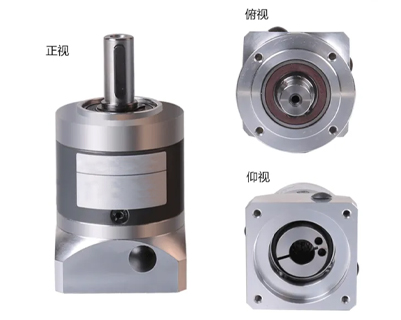
A planetary gear reducer is a reducer composed of one or more sets of planetary gears, sun gears, internal ring gears, etc. The small gear in the middle of the figure is the sun gear, and the multiple self rotating gears distributed in the inner ring gear and sun gear are the planetary gears.
In depth analysis of the parameters, materials, types, and transmission logic of planetary gearbox gear systems
A planetary gear reducer is a reducer composed of one or more sets of planetary gears, sun gears, internal ring gears, etc. The small gear in the middle of the figure is the sun gear, and the multiple self rotating gears distributed in the inner ring gear and sun gear are the planetary gears.
1、 Parameters of planetary gearbox gears
The diameter d of the dividing circle is equal to the modulus m multiplied by the number of teeth z, that is, m=d/z.
Understanding of Modulus
It is directly related to the tooth pitch, reflecting the size of the gear tooth thickness, and is an important indicator of the size of the gear teeth themselves.
Among the numerous parameters of gears, the modulus m is a derived parameter. Figure 1 shows its derivation process.
We defined the tooth pitch p and derived d=p/π Z through the formula π d=pZ. On this basis, we artificially set the modulus m equal to p/π as the basic parameter for gear design.
Dividing circle: The circle in standard gears where the groove width and tooth thickness are equal, i.e. e=s.
Gears are not isolated, they often appear in pairs to form transmission ratios. This raises a core question: how to ensure that two gears of different sizes can mesh smoothly?
Obviously, to achieve this, their modulus and pressure angle must be equal. However, from the perspective of the inventor of gears, things are not always so intuitive. At first, people may only use rectangular teeth without the concept of involute.
To ensure smooth meshing of two gears, the tooth thickness of one gear must be equal to the tooth groove width of the other gear. Otherwise, they may get stuck. Therefore, it is necessary to find a physical quantity that can directly reflect the thickness of gear teeth.
Finally, the wise ancestors discovered the quantity of tooth pitch. As long as the tooth pitch is equal, regardless of the number of teeth on the gears, they can mesh smoothly. This discovery is crucial.
Once the tooth pitch is determined, we can obtain the circumference by multiplying the number of teeth by the tooth pitch. Furthermore, we can derive the definition of modulus: modulus actually represents the tooth pitch, that is, the size of the teeth. This is the physical meaning of modulus.
The dividing circle is a dimension reference selected for the convenience of gear design and manufacturing. The gear indexing circle has standard modulus and standard pressure angle.
Pressure angle: The angle α 'between the normal of the tooth profile contact point and the tangent of the indexing circle.
The magnitude of the pressure angle has a significant impact on the performance of gears. The smaller the pressure angle, the higher the gear overlap, thereby reducing noise, but this may also lead to more wear and efficiency loss. On the other hand, the larger the pressure angle, the shorter the meshing line of the gear, which helps to improve the contact stress and tooth root strength, but may also impose higher requirements on the bearing and increase friction and noise. In practical applications, common pressure angle values include 15 °, 17.5 °, 20 °, and 25 °. For example, gears with a 20 ° pressure angle are commonly used in light load and high-speed transmission scenarios, while gears with a 25 ° pressure angle are more suitable for heavy-duty applications.
2、 Material of planetary gearbox gears
In the selection of gear materials, we need to consider many factors. The tooth body of a gear needs to have anti fracture ability, while the tooth surface needs to have anti pitting, anti wear, and anti bonding ability, which requires meeting the characteristics of high tooth surface hardness and good core toughness.
The planetary gearbox gears are made of alloy steel 20CrMnTi (which is a type of carburizing steel commonly used in the manufacturing of automotive transmission gears. This steel contains an appropriate amount of carbon (0.17% -0.24%) and is infused with elements such as Cr, Mn, and Ti, making it highly hardenable). After appropriate heat treatment, its tensile strength is ≥ 1080 MPa and yield strength is ≥ 835 MPa. It can withstand large loads and is suitable for manufacturing parts that can withstand heavy loads. It has good toughness and strong wear resistance.
3、 Gear processing technology for planetary gearbox
The machining process of gears is also crucial! The processes of gear forging, flat drilling of center holes, precision machining of gear blanks, gear hobbing, gear hobbing, gear shaving, gear grinding, spline rolling, and heat treatment are interrelated to complete the production and processing of gears.
Raw material manufacturing: The raw material manufacturing of gear components such as sun gears, planetary gears, and internal gear rings is a step. This step requires the selection of forging or precision casting methods based on design and dimensions. Forging can optimize the internal structure of metals, enhance strength and toughness; Precision casting has more advantages in controlling the dimensional accuracy of complex shaped blanks.
Gear profile machining: The machining of sun gears and planetary gears often uses hobbing and grinding methods. During the gear hobbing process, the rolling cutter on the gear hobbing machine moves relative to the blank, cutting out the tooth profile with high efficiency. To achieve higher precision after gear hobbing, grinding is often used as a supplement. Grinding can correct tooth profile errors and ensure smooth meshing. The processing of internal gear rings is relatively complex, and the gear hobbing or pulling method is often used. Gear hobbing is the use of a gear hobbing cutter to process the tooth profile of the internal gear ring on a gear hobbing machine.
Related News