
Humanoid robot - harmonic reducer
Release Time:
2025-04-18
The reducer is an intermediate mechanism that connects the power source and the actuator, and has the function of matching speed and transmitting torque. In humanoid robots, reducers are one of the core precision components, mainly used to provide stable power support for joint movements, accounting for 30% of the value. The precision reducers used in robots mainly include harmonic reducers, planetary reducers, and RV reducers.
Humanoid robot - harmonic reducer
The reducer is an intermediate mechanism that connects the power source and the actuator, and has the function of matching speed and transmitting torque. In humanoid robots, reducers are one of the core precision components, mainly used to provide stable power support for joint movements, accounting for 30% of the value. The precision reducers used in robots mainly include harmonic reducers, planetary reducers, and RV reducers.
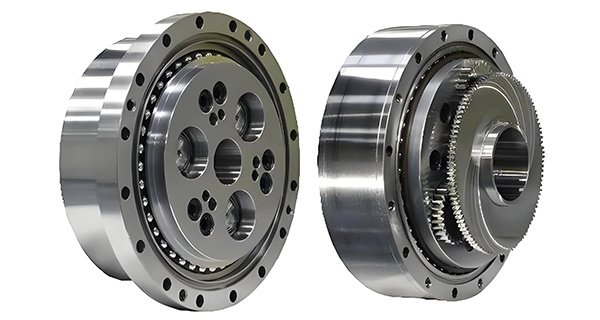
Harmonic reducer is a precision transmission device that uses the principle of harmonic gear transmission to achieve deceleration transmission. It mainly consists of three parts: wave generator, flexible wheel, and rigid wheel. During the motion, the wave generator causes the flexible wheel to produce controllable elastic deformation, thereby meshing with the rigid wheel to achieve deceleration and power transmission. It has the characteristics of compact structure, large transmission ratio, high accuracy, and low noise.
Working principle
The harmonic reducer is mainly composed of four basic components: wave generator, flexible gear (flexible wheel), flexible bearing, and rigid gear (rigid wheel). The wave generator is the active component, with one of the rigid and flexible wheels as the passive component and the other as the fixed component. When the wave generator is installed in the flexible wheel, it forces the profile of the flexible wheel to change from circular to elliptical. The teeth near the long axis end fully mesh with the teeth of the rigid wheel, while the teeth near the short axis end completely disengage from the rigid wheel. The teeth in other sections of the circumference are in a transitional state of meshing and disengagement. When the wave generator rotates continuously in a certain direction, the deformation of the flexible wheel constantly changes, causing the meshing state between the flexible wheel and the rigid wheel to also change continuously, from meshing in, meshing out, disengaging, re meshing... This cycle repeats itself, thereby achieving slow rotation of the flexible wheel relative to the rigid wheel in the opposite direction of the wave generator, achieving the purpose of deceleration transmission.
characteristic
Large transmission ratio: The transmission ratio of single-stage harmonic gear transmission can reach 70-500, and in some devices, it can even reach 1000. The multi-stage transmission ratio can reach over 30000, which can meet the needs of humanoid robots for different motion speeds and torques.
High precision: Under the same gear precision level, the transmission error of harmonic reducer is only about 1/4 of that of ordinary cylindrical gear transmission. At the same time, the deformation of the flexible wheel can be increased by slightly changing the radius of the wave generator, making the backlash very small and even achieving backlash free meshing, ensuring the accuracy of the humanoid robot's movements.
Small size and light weight: Compared with general reducers, harmonic gear reducers can reduce their volume by 2/3 and weight by 1/2 under the same output torque, which is very important for humanoid robots with strict space and weight limitations.
Strong load-bearing capacity: In harmonic transmission, the meshing between teeth is surface contact, and with a relatively large number of teeth meshing simultaneously, the unit area load is small, resulting in a higher load-bearing capacity than other transmission forms.
High transmission efficiency: The sliding of the meshing parts of the gear teeth is very small, reducing the power loss caused by friction. While obtaining a high reduction ratio, it can maintain high efficiency and achieve miniaturization of the driving motor.
Application site
Mainly used in light load parts such as the forearm, wrist, and hand of humanoid robots. In these areas, high requirements are placed on volume and flexibility. The small size, light weight, high transmission ratio, and high precision of harmonic reducers enable them to fully leverage their advantages and assist robots in completing various flexible and precise movements.
Key technology design
Structural optimization and kinematic design: Adopting a double arc tooth profile design to optimize the distribution of contact stress on the tooth surface and reduce friction losses; The flexible wheel is designed as a thin-walled cylindrical structure, and the thickness distribution is optimized through finite element analysis to improve fatigue resistance performance; Referring to the integrated design of motor reducer, a frameless torque motor is directly integrated with a harmonic reducer to reduce intermediate connections, lower weight, and improve dynamic response.
Materials and surface treatment technology: The flexible wheel is made of nickel based alloy, which has high yield strength and better fatigue resistance than traditional alloy steel. The wear resistance of the tooth surface is enhanced through laser cladding technology; The rigid wheel and shell are made of titanium alloy, balancing lightweight and high rigidity, and the friction coefficient is reduced through DLC coating.
Dynamic performance optimization: Based on modal testing equipment, combined with acceleration sensors and force hammers, identify the natural frequency of the system and optimize the structural resonance point to reduce vibration amplitude; Integrating embedded torque sensors and encoders, dynamically adjusting output torque through PID algorithm to adapt to unstructured motion scenarios of humanoid robots.
Related News