
The application of harmonic reducers in robots: driving the core components of future intelligence
Release Time:
2025-04-16
With the rapid development of robotics technology, its application scenarios have expanded from industrial manufacturing to multiple fields such as healthcare, services, and aerospace. In this process, the performance of precision transmission components directly determines the flexibility, accuracy, and reliability of the robot. Harmonic Drive, as a high-precision, lightweight,
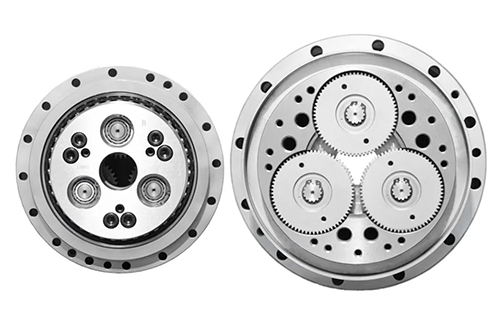 The application of harmonic reducers in robots: driving the core components of future intelligence
With the rapid development of robotics technology, its application scenarios have expanded from industrial manufacturing to multiple fields such as healthcare, services, and aerospace. In this process, the performance of precision transmission components directly determines the flexibility, accuracy, and reliability of the robot. Harmonic Drive, as a high-precision, lightweight, and high torque density transmission device, has become the core component of robot joint drive due to its unique technological advantages. This article will start from its technical principles, deeply explore its specific applications in various types of robots, and combine market trends and localization processes to look forward to its future development direction.
1、 The working principle and technological breakthrough of harmonic reducer
1.1 Basic Structure and Transmission Mechanism
The core of a harmonic reducer consists of three parts: Wave Generator, Flexspline, and Circular Spline. Its working principle is based on elastic deformation to achieve transmission:
The wave generator (usually connected to the motor shaft) causes elastic deformation of the flexible wheel through an elliptical cam;
The teeth of the flexible wheel and the teeth of the rigid wheel are misaligned and meshed when the wave generator rotates, and deceleration is achieved through the difference in the number of teeth (usually a reduction ratio between 30:1 and 320:1).
This process does not require the rigid contact of traditional gears, has low friction loss, and can achieve zero backlash transmission with an accuracy of ± 1 arcsecond, far exceeding ordinary planetary reducers.
1.2 Technological Breakthrough: Innovation from Materials to Design
Material Science Upgrade: The flexible wheel adopts high-strength alloy steel (such as 40CrNiMoA) combined with vacuum nitriding process, with a surface hardness of HRC60 or above, and the service life is increased from 10000 hours to 20000 hours;
Three wave transmission technology: By superimposing three sets of harmonic transmission waves, vibration is reduced by 50%, torque fluctuation is controlled within ± 3%, and it is suitable for high-speed and high load scenarios;
Integrated design: Integrating the reducer, motor, and encoder (such as Harmonic Drive's "Servo Actuator" module), reducing the volume by 40%, and adapting to the narrow joint space of humanoid robots.
2、 The core application scenarios of harmonic reducers in robots
2.1 Industrial Robots: High precision Manufacturing of 'Joint Bones'
In scenarios such as automotive welding and 3C electronic assembly, industrial robots require high precision in repeated positioning (usually within ± 0.05mm). Application cases of harmonic reducers include:
Six axis articulated robot: Taking KUKA KR 10 R1100 as an example, its wrist joints adopt harmonic reducers, and the trajectory repetition accuracy reaches ± 0.03mm, which is 20% higher than traditional RV reducers;
Collaborative Robot (Cobot): Each joint of the U-O UR5e is equipped with a harmonic reducer, achieving fast response and safe obstacle avoidance during human-machine collaborative work, with a torque density of 15 Nm/kg.
Data support: By 2023, the penetration rate of harmonic reducers in global industrial robots has reached 65%, with collaborative robots accounting for over 80% of the market.
Related News