
Servo motor - a command following motor
Release Time:
2025-04-14
Servo motor "can be understood as a motor that follows the command of a control signal: the rotor remains stationary before the control signal is issued; When the control signal is issued, the rotor immediately rotates; When the control signal disappears, the rotor can immediately stop rotating.
Servo motor - a command following motor
Servo motor "can be understood as a motor that follows the command of a control signal: the rotor remains stationary before the control signal is issued; When the control signal is issued, the rotor immediately rotates; When the control signal disappears, the rotor can immediately stop rotating.
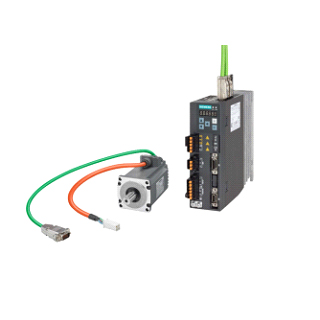
A servo motor is a micro motor used as an actuator in automatic control devices, whose function is to convert electrical signals into angular displacement or angular velocity of the shaft.
Working principle
A servo motor consists of three parts: a motor, an encoder, and a controller. The rotor inside the servo motor is a permanent magnet, and the U/V/W three-phase electricity controlled by the driver forms an electromagnetic field. The rotor rotates under the action of this magnetic field. At the same time, the encoder provided by the motor feeds back the signal to the driver, and the driver compares the feedback value with the target value to adjust the angle of rotor rotation. The accuracy of servo motors depends on the accuracy (number of lines) of the encoder.
classification
Servo motors are also known as executive motors or control motors. In an automatic control system, a servo motor is an actuator that converts signals (control voltage or phase) into mechanical displacement, that is, it converts received electrical signals into a certain speed or angular displacement of the motor. Servo motors are divided into DC and AC types.
1. Communication servo motor
The structure of the stator of an AC servo motor is basically similar to that of a capacitor phase separated single-phase asynchronous motor, as shown in Figure 1. The stator is equipped with two windings located 90 ° apart from each other, one of which is the excitation winding Rf, which is always connected to the AC voltage Uf; The other is to control winding L and connect the control signal voltage Uc. So AC servo motors are also known as two servo motors.
The rotor of an AC servo motor is usually designed as a squirrel cage, but in order to provide the servo motor with a wide speed range, linear mechanical characteristics, no "self rotation" phenomenon, and fast response performance, it should have two characteristics compared to ordinary motors: high rotor resistance and low moment of inertia. There are currently two types of rotor structures that are widely used: one is a squirrel cage rotor made of high resistivity conductive materials with high resistivity bars. In order to reduce the rotational inertia of the rotor, the rotor is made slender; Another type is a hollow cup-shaped rotor made of aluminum alloy, with a very thin cup wall of only 0.2-0.3 mm. In order to reduce the magnetic resistance of the magnetic circuit, a fixed internal stator should be placed inside the hollow cup-shaped rotor, as shown in Figure 2. Hollow cup-shaped rotors have a small moment of inertia, rapid response, and smooth operation, making them widely used.
Permanent magnet AC servo motor
Since the 1980s, with the development of integrated circuits, power electronics technology, and AC variable speed drive technology, permanent magnet AC servo drive technology has made outstanding progress. Famous electrical manufacturers in various countries have successively launched their own AC servo motor and servo drive series products and continuously improved and updated them. The communication servo system has become the main development direction of contemporary high-performance servo systems, which poses a crisis of phasing out the original DC servo. After the 1990s, the commercialized AC servo systems in various countries around the world were driven by sine wave motors with fully digital control. The development of communication servo drive devices in the field of transmission is advancing rapidly. The main advantages of permanent magnet AC servo motors compared to DC servo motors are:
⑴ Electric brushes and commutators are reliable in operation and require low maintenance and upkeep.
⑵ The heat dissipation of the sub winding is relatively convenient.
⑶ Small inertia, easy to improve the system's speed.
⑷ Suitable for high-speed and high torque working conditions.
⑸ Under the same power, it has a smaller volume and weight.
Related News