
A brief explanation of stepper motors, you will understand after reading it
Release Time:
2025-04-12
Stepper motors, as executive components, are one of the key products of mechatronics integration and are widely used in various automation control systems. With the development of microelectronics and computer technology, the demand for stepper motors is increasing day by day, and they have applications in various fields of the national economy.
A brief explanation of stepper motors, you will understand after reading it
Stepper motors, as executive components, are one of the key products of mechatronics integration and are widely used in various automation control systems. With the development of microelectronics and computer technology, the demand for stepper motors is increasing day by day, and they have applications in various fields of the national economy.
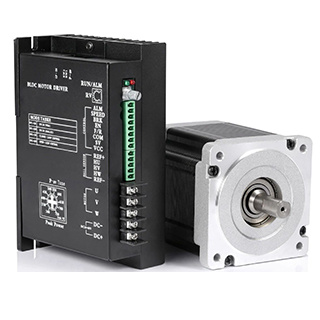
Basic structure
Stator: Typically composed of multiple magnets with excitation windings wound around them. By applying currents of different sequences and sizes to the excitation winding, different magnetic fields will be generated.
Rotor: It is the rotating part of a motor with teeth or magnets on it. The teeth or magnets of the rotor interact with the magnets of the stator, generating torque under the action of the stator magnetic field, thereby causing the rotor to rotate.
Working principle
The working principle of stepper motors is based on electromagnetics. The current passes through the electromagnetic coil of the stator, generating a magnetic field. This magnetic field interacts with the permanent magnets on the rotor, causing the rotor to rotate by a certain step angle. The control circuit sends a series of pulse signals to the motor, each corresponding to a step angle, to control the rotation of the motor. The term 'stepper' refers to a motor moving at a fixed step angle. A stepper motor drives the rotor to rotate at a certain step angle by controlling pulse signals.
Characteristics of stepper motors
1. Accuracy
Stepper motors can rotate at a fixed step angle, providing relatively high position control accuracy.
2. Simple control
Controlling a stepper motor only requires sending pulse signals, which is relatively simple to control and suitable for open-loop systems.
3. Zero speed torque
In the stopped state, the stepper motor can maintain a certain torque without the need for additional mechanical locking.
4. Low speed and high torque
At low speeds, stepper motors typically have high torque, making them suitable for applications that require high torque but low speed.
4. Brushless and frictionless
Due to the brushless design, stepper motors do not require brushes, reducing friction and wear.
Stepper motors are widely used in applications that require precise position and speed control, such as CNC machine tools, printers, medical equipment, etc. Their high precision and fast response characteristics make them very popular in these applications. The advantages of stepper motors include high precision, fast response, and simple open-loop control. However, their efficiency is low and they may experience out of step phenomena during high-speed operation. To overcome these drawbacks, modern stepper motors typically use subdivision drive technology to further improve their control accuracy and performance.
Related News