
Do you know about planetary gearboxes?
Release Time:
2025-04-08
A planetary gearbox is an industrial transmission device designed to increase the output torque of a system by reducing speed. The main transmission structure of the planetary gearbox is: planetary gear, sun gear, and external gear ring. Named "planetary gearbox" due to its structure. The structure is relatively compact, with small return clearance, high precision, long service life, and the rated output torque can be made very large. But the price is slightly higher.
Do you know about planetary gearboxes?
A planetary gearbox is an industrial transmission device designed to increase the output torque of a system by reducing speed. The main transmission structure of the planetary gearbox is: planetary gear, sun gear, and external gear ring. Named "planetary gearbox" due to its structure. The structure is relatively compact, with small return clearance, high precision, long service life, and the rated output torque can be made very large. But the price is slightly higher.
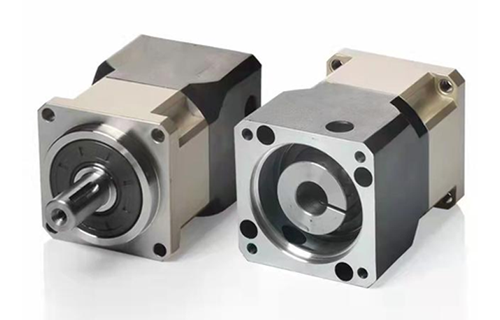
Planetary reducers are generally used when high torque is required in limited space, that is, small volume and large torque, and their reliability and lifespan are better than those of spur gear reducers. Positive gear reducers are used for applications with lower current consumption, low noise, high efficiency, and low cost.
The characteristics of planetary gearboxes are small size, high output torque, and high transmission efficiency. They can be used in any place with these requirements, such as cutting machines, bucket wheel machines, cement production lines, oil processing, fertilizers, power plants, cement, glass, and many other industries.
Structural principle
Planetary gear mechanism: This is the core part of a planetary gearbox, consisting of a sun gear, planetary gears, and an inner ring gear. The sun gear is located at the center, surrounded by multiple planet gears that mesh with both the sun gear and the ring gear. When the sun gear inputs power, the planetary gears will perform orbital and rotational movements between the sun gear and the ring gear, thereby achieving the functions of deceleration and torque amplification.
Transmission method: Power is transmitted to the sun gear through the input shaft, which drives the planetary gear to rotate. The rotation of the planetary gear is then transmitted to the output shaft through the planetary carrier. Due to the rotation of the planetary gears during their revolution, the output shaft rotates at a lower speed than the input shaft, achieving the purpose of deceleration. Meanwhile, according to the principle of force transmission, the torque is correspondingly amplified.
characteristic
Small size and light weight: The planetary reducer adopts a compact planetary gear structure. Compared with traditional gear reducers, it has a smaller volume and weight under the same transmission ratio and load capacity, making it easy to install and arrange.
High transmission efficiency: Planetary gear transmission has the characteristic of multi tooth meshing, which can achieve uniform power transmission, reduce energy loss, and the transmission efficiency can generally reach over 90%.
Wide range of transmission ratios: By changing the combination of teeth in the sun gear, planetary gear, and inner ring gear, various different transmission ratios can be obtained to meet different work requirements. The transmission ratio range can usually range from a few to several hundred or even higher.
Strong load-bearing capacity: Multiple planetary gears simultaneously share the load, allowing the planetary gearbox to withstand large torque and impact forces, making it suitable for high load work environments.
Smooth operation and low noise: The meshing method of planetary gears results in minimal vibration and impact during transmission, ensuring smooth operation and relatively low noise.
application area
Industrial automation: Used in various transmission systems of automated production lines, such as robots, conveyor belts, CNC machine tools, etc., for precise control of speed and torque, achieving high-precision motion control.
New energy: In the fields of wind and solar power generation, it is used to convert the high-speed rotation of generators into low-speed rotation suitable for grid connection, while increasing torque output to adapt to different power generation conditions.
Transportation: In the drive system of electric vehicles, the high speed and low torque of the motor can be converted into low speed and high torque suitable for vehicle operation, improving the vehicle's power performance and range.
Metallurgical mines: In mining and metallurgical equipment such as crushers, ball mills, elevators, etc., they can withstand huge loads and provide stable power transmission for equipment.
Related News