
Decrypting Robot Hand: How Reducer Shapes a Smart Hand
Release Time:
2025-04-07
In the current era of rapid technological development, robot technology is integrating into our lives at an unprecedented speed. From industrial production to daily life services, robots are everywhere. As a key component for robots to interact with the outside world, the dexterity of the robot hand directly determines its ability to complete complex tasks. Among the numerous core components of a robotic hand, the gearbox plays a crucial role, and its performance has a profound impact on the dexterity of the robotic hand.
Decrypting Robot Hand: How Reducer Shapes a Smart Hand
In the current era of rapid technological development, robot technology is integrating into our lives at an unprecedented speed. From industrial production to daily life services, robots are everywhere. As a key component for robots to interact with the outside world, the dexterity of the robot hand directly determines its ability to complete complex tasks. Among the numerous core components of a robotic hand, the gearbox plays a crucial role, and its performance has a profound impact on the dexterity of the robotic hand.
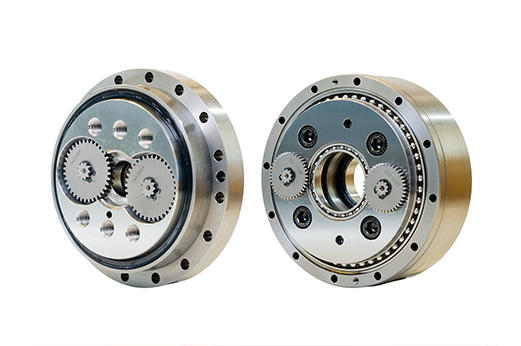
1、 How many reducers do robots have on their hands?
The number of reducers on a robot's hand varies depending on the type and design of the robot. Here are some common situations:
Humanoid robot hand: Generally speaking, if it is a common humanoid robot with 5 fingers per hand, and each finger joint completes some movements through a wire or encoder, an additional decelerator is required for each finger. Each hand may require 4-5 decelerators, and for two hands, 8-10 decelerators are needed. According to Japanese company Hamonako, humanoid robotic hands may require the use of 30 reducers.
Industrial robot hand
Two finger or three finger gripper: This type of industrial robot hand usually has a relatively simple structure and is mainly used to grasp and place objects of specific shapes and sizes. Generally, 1-2 reducers are equipped at the joints of each finger to control the opening and closing of the fingers and the gripping force. The entire hand may require a total of 2-6 reducers.
Multi joint humanoid hand: Some high-end industrial robotic hands are designed with multi joint structures similar to human hands to achieve more complex operational tasks. The number of reducers may be similar to that of humanoid robotic hands, and each hand may require 5-10 or even more reducers, depending on the number and design of joints.
Collaborative robotic hands typically require high flexibility and precision to collaborate with humans. The number of reducers on their hands may also vary depending on specific functions and structural designs, with each hand typically having 3-8 reducers.
2、 What types of reducers are on a robot's hand?
1. Harmonic reducer
Small in size and lightweight (suitable for dexterous hands or finger joints).
High precision, suitable for fine grasping
Good anti vibration performance, able to adapt to dynamic operation
Applications: Finger joints, collaborative robot hands
2. RV gearbox
High rigidity, high torque (suitable for palm rotation or thumb drive).
Long lifespan and high reliability.
Application: The main driver for wrist rotation joints and palm opening and closing.
3. Planetary gearbox
Medium reduction ratio, efficient
Compact structure, suitable for multi-stage deceleration combination
Application: Fine tuning of arm joints and palms.
4. Right angle reducer
Change the transmission direction (90 °) to save space
Low cost, easy maintenance
Application: Wrist pitch or side swing joint (such as the natural bending direction of the human forearm)
Related News