
Seven steps for selecting high-precision planetary gearboxes
Release Time:
2025-03-12
Reducer, simply understood as "reducing speed and increasing force", on the one hand: by reducing the motor speed and increasing the torque, it increases the force of the actuator (such as the electric cylinder), providing necessary power support for the equipment; On the other hand, by reducing the speed of the motor output shaft, the control accuracy of the speed can be improved, thereby achieving precise speed control. Widely used in various industrial fields, such as machine tools, printing equipment, packaging machinery, automobile manufacturing, medical machinery, etc.
Seven steps for selecting high-precision planetary gearboxes
Reducer, simply understood as "reducing speed and increasing force", on the one hand: by reducing the motor speed and increasing the torque, it increases the force of the actuator (such as the electric cylinder), providing necessary power support for the equipment; On the other hand, by reducing the speed of the motor output shaft, the control accuracy of the speed can be improved, thereby achieving precise speed control. Widely used in various industrial fields, such as machine tools, printing equipment, packaging machinery, automobile manufacturing, medical machinery, etc.
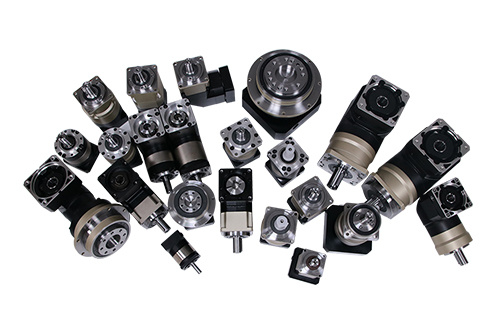
Basic structure and working principle
Core components
Sun Gear
The central input gear meshes with the planetary gears to transmit power.
Planet Gears
Multiple gears distributed around the sun gear are fixed on the planet carrier through rolling bearings and mesh with the inner ring gear.
Ring Gear
The fixed or rotating gear inside the casing meshes with the planetary gear to form power distribution.
Planetary Carrier
The rotating frame that supports planetary gears is usually used as the output end.
Transmission principle
The power is input from the sun gear, driving the planetary gears to orbit around the sun gear and output through the planetary carrier. High reduction ratio is achieved through multi-stage series connection (such as 3-stage deceleration), while using power splitting to reduce single tooth load and improve transmission efficiency (up to 97% or more).
The Seven Steps of Selection
Step: Determine the required output torque, output speed, etc. of the device;
Step 2: Select the base of the reducer based on the output torque, and try to match it with the motor base as much as possible;
Step 3: Calculate whether the actual output torque exceeds the torque limit, that is, the motor torque * N (speed ratio) ≤ the rated output torque of the reducer;
Step 4: Select the required model based on the speed ratio and machine base number, and divide it into single-stage, two-stage, multi-stage, etc;
Step 5: Find the corresponding numerical model based on the numerical model, and confirm whether the motor interface corresponds to the input interface of the reducer;
Step 6: Special working conditions such as high and low temperatures, waterproofing, radiation protection, corrosion protection, etc. can be notified in advance;
Step 7: If there are special usage requirements, please inform us in advance, such as having a hand crank, clutch, etc.
Related News