
What is worm gear transmission
Release Time:
2025-03-05
Worm gear transmission is composed of a worm and a worm wheel, used to transmit motion and power between intersecting shafts, usually with a 90 ° angle between the two shafts. In general worm gear transmission, the worm gear is used as the active component. From an external perspective, the worm is similar to a bolt, while the worm gear resembles a helical cylindrical gear. During operation, the worm gear teeth slide and roll along the helical surface of the worm. In order to improve the contact between the gear teeth, the worm wheel is made into a circular arc shape along the tooth width direction, so that it wraps around the worm part. In this way, when the worm gear and worm wheel mesh, it is in line contact rather than point contact.
What is worm gear transmission
Worm gear transmission is composed of a worm and a worm wheel, used to transmit motion and power between intersecting shafts, usually with a 90 ° angle between the two shafts. In general worm gear transmission, the worm gear is used as the active component. From an external perspective, the worm is similar to a bolt, while the worm gear resembles a helical cylindrical gear. During operation, the worm gear teeth slide and roll along the helical surface of the worm. In order to improve the contact between the gear teeth, the worm wheel is made into a circular arc shape along the tooth width direction, so that it wraps around the worm part. In this way, when the worm gear and worm wheel mesh, it is in line contact rather than point contact.
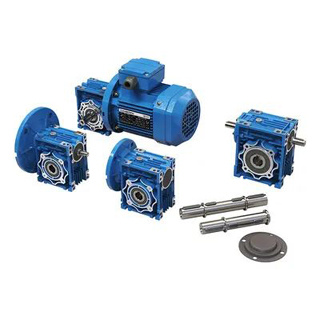
Worm gear refers to a gear that has one or several helical teeth and meshes with a worm wheel to form a staggered shaft gear pair. Its indexing surface can be cylindrical, conical, or toroidal, and there are four categories: Archimedean worm, involute worm, normal profile worm, and conical enveloping cylindrical worm.
Advantages of worm gear transmission:
Single stage transmission ratio is large, generally i=10~100. In the indexing mechanism that transmits power, it can reach up to 1500 or more.
The same mesh is in linear contact and can withstand significant power.
Compact structure, smooth transmission, and low noise.
When the worm gear lift angle is less than the equivalent friction angle between the gears, it has reverse stroke self-locking, that is, only the worm gear can drive the worm wheel, and the worm wheel cannot drive the worm gear.
Disadvantages of worm gear transmission:
The two axes are perpendicular, and the linear velocity of the two wheel nodes is perpendicular, so the relative sliding speed is high, which is prone to heating and wear.
Low efficiency, generally ranging from 0.7 to 0.8; Worm gears with self-locking properties have lower efficiency, generally less than 0.5.
Does a worm gear reducer necessarily have self-locking performance? No, there are prerequisites.
When the lead angle is less than the friction angle, the worm gear reduction mechanism can self lock. Usually, when choosing a gear reducer, users must use power-off protection or brake motors, so gear reducers will choose motors with brakes to achieve the purpose of stopping, but it does not mean stopping, there is still a little bit of inertia.
What is self-locking? The concept of self-locking is that no matter how much force is applied, it cannot be started. No matter how much inertia is applied, as long as the active component stops running, the whole machine can brake. Worm gear reducers have this self-locking performance. Gear reducers do not have self-locking properties, while worm gear reducers have reliable self-locking properties when the reduction ratio is 1:30 or higher, and the larger the reduction ratio, the better the self-locking performance.
Related News