
RV reducer, structural characteristics, working principle and design calculation
Release Time:
2025-02-26
RV reducer is a high-precision and high rigidity precision reduction device widely used in industrial robots, CNC machine tools and other fields. The following provides a detailed explanation from three dimensions: structural characteristics, working principles, and design calculation analysis:
RV reducer, structural characteristics, working principle and design calculation
RV reducer is a high-precision and high rigidity precision reduction device widely used in industrial robots, CNC machine tools and other fields. The following provides a detailed explanation from three dimensions: structural characteristics, working principles, and design calculation analysis:
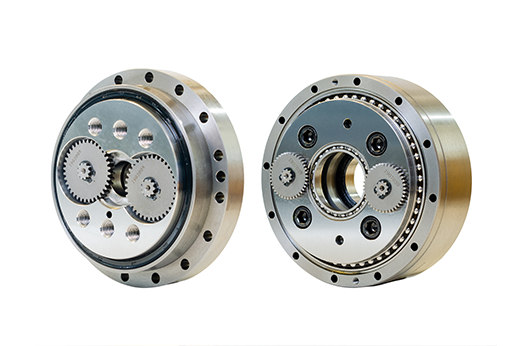
1、 Structural characteristics
1. Dual stage deceleration structure
Grade: Planetary gear transmission
Composed of sun gear, planetary gear, and ring gear, it achieves initial deceleration (usually 3-10 times the speed ratio).
Second stage: Cycloid pinwheel transmission
By driving the cycloidal gear with an eccentric shaft and meshing with the needle teeth, a secondary reduction is achieved (with a speed ratio of up to 30-100 times).
2. Core components
Cycloid Disk: It adopts a cycloidal tooth profile and meshes with needle teeth to achieve high-precision transmission.
Needle Bearing Ring: Fixing the needle teeth to form a rigid support.
Crankshaft: Connecting planetary gears and cycloid gears, transmitting power and achieving eccentric motion.
Output Flange: integrates cycloidal wheel motion and outputs torque.
2、 Working principle
1. Power transmission path
Input shaft → planetary gear reduction → eccentric motion of crankshaft → cycloidal gear revolution+rotation → needle tooth constraint → output disc rotation.
2. Kinematic process
Eccentric rotation of crankshaft: The planetary gear drives the crankshaft, causing the cycloidal gear to undergo eccentric revolution.
Cycloid gear meshing: Cycloid gear teeth periodically mesh with needle teeth, and are constrained by the needle tooth shell to produce reverse rotation.
Output synthesis: The rotation of the cycloid wheel is transmitted to the output disc through the crankshaft pin, forming a deceleration output.
3、 Applications and Trends
Typical scenarios: Industrial robot joints (accounting for 15%~30% of the cost), precision turntables, aerospace agencies.
Technological trends: lightweight (aluminum alloy shell), integrated (built-in encoder), low noise (topology optimized tooth profile).
Related News