
The motor is right beside me What is an electric motor (commonly known as a motor)?
Release Time:
2024-09-13
At present, motors have developed into a unique category of motors. With the production of new application scenarios and the research and development of new materials, it will continue to improve its own theory; Develop and research new varieties; Strengthen the close integration with high-tech and new technologies, and expand their functions; Improve the production technology of micro motors, enhance quality, and reduce costs.
An electric motor is a device that converts electrical energy into mechanical energy. Simply put, it rotates the motor through the principle of electromagnetic induction by energizing it, thereby driving objects forward and backward, and performing mechanical movements such as flight and vibration.
According to different classification standards, motors can be divided into DC motors, AC motors, synchronous motors, asynchronous motors, iron core motors, hollow cup motors, brushless motors, etc., and different motors can be adapted according to different application scenarios.
Electric motors are actually everywhere
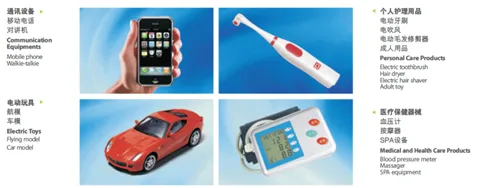
New energy vehicles, electric toy cars
Driven by the core motor, the tire rotates
Model aircraft and unmanned aerial vehicles
The motor drives the propeller to rotate
Electric toothbrush
The motor causes the brush head to oscillate at high frequency
Electric screwdriver
The motor drives the blade to rotate
Robot
Motor drives the extension and flexion of fingers or joints
Electric fingerprint lock
The motor drives the rotation of the lock cylinder
adult erotica products
Vibration caused by the addition of an eccentric hammer to the motor
Game controller
The motor rotates according to the game plot, causing the controller to vibrate
Smart Home
The motor is used in conjunction with a water pump to automatically pump water in daily tea sets, including electric curtain rods, electric fans, and hair dryers
Common motors and structures
Permanent magnet DC hollow cup motor
Using high-performance neodymium iron boron magnetic material, the core component is a coreless hollow cup rotor. Motor products have the characteristics of small size, light weight, low inertia, high efficiency, long life, fast response speed, good speed regulation and servo characteristics.
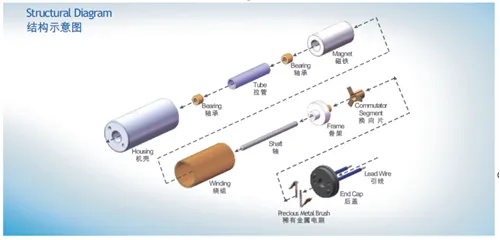
Permanent magnet DC iron core motor
Adopting ultra-thin soft magnetic silicon steel sheets with low iron loss, high magnetic permeability and low loss. The enameled wire is embedded around the iron core, with a stable structure and high magnetic field utilization efficiency. Motor products have the characteristics of strong universality, wide application range, and low cost.
Permanent magnet brushless DC motor
The motor adopts electronic commutation, with a lifespan far exceeding mechanical commutation. It has diverse structural forms, including internal and external rotor structures.
Motor products have the characteristics of extremely long lifespan, convenient speed adjustment, large starting torque, and low failure rate.
Vibration motor
Micro hollow cup vibration motor: The motor body adopts a hollow cup structure, equipped with an eccentric hammer, and the motor rotates to generate vibration. Micro flat vibration motor: The motor is button like in shape, with a built-in eccentric hammer, and the motor rotates to generate vibration. All motors we produce can be equipped with eccentric hammers made of iron, copper, or tungsten to form vibration motors.
The development trend of motors
As a simple power output "torque motor", the motor has been developing since the 19th century, to the "intelligent motor" with control function in the 20th century, and then to the new motor that meets the requirements of coexisting with the earth's environment, integrating with the network, and robots in the 21st century. It continuously absorbs new scientific research achievements and constructs a new era of motors.
At present, motors have developed into a unique category of motors. With the production of new application scenarios and the research and development of new materials, it will continue to improve its own theory; Develop and research new varieties; Strengthen the close integration with high-tech and new technologies, and expand their functions; Improve the production technology of micro motors, enhance quality, and reduce costs.
Related News