
Classification and Introduction of Gearboxes
Release Time:
2025-02-16
A reducer is a widely used mechanical transmission device used to reduce input speed and increase output torque. The main function of a reducer is to convert the high-speed rotating power system into the required low-speed high torque output, enabling effective control and driving of the workload. Reducer has the advantages of high stability, high transmission efficiency, and high transmission accuracy, so it is widely used in many industries, such as mechanical manufacturing, machine tools, food processing, mining, metallurgy, and so on.
1、 Overview of gearbox
A reducer is a widely used mechanical transmission device used to reduce input speed and increase output torque. The main function of a reducer is to convert the high-speed rotating power system into the required low-speed high torque output, enabling effective control and driving of the workload. Reducer has the advantages of high stability, high transmission efficiency, and high transmission accuracy, so it is widely used in many industries, such as mechanical manufacturing, machine tools, food processing, mining, metallurgy, and so on.
2、 Basic principle of gearbox
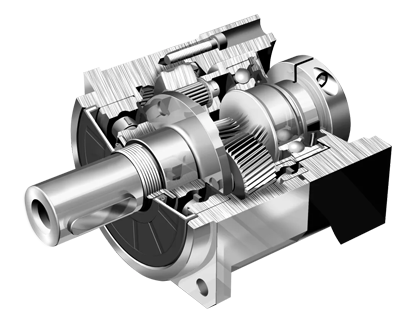
The basic principle of a gearbox is to convert input high-speed rotational motion into output low-speed rotational motion by transmitting power and motion. A reducer is generally composed of an input shaft, an output shaft, a gear transmission mechanism, and a housing. When the input shaft rotates, the power transmitted to the gear transmission mechanism will be transmitted and converted, ultimately driving the output shaft to rotate. The reduction ratio is an important parameter of the gearbox, which determines the ratio of the input shaft speed to the output shaft speed. In practical applications, it is also necessary to consider indicators such as the torque transmission capacity, transmission efficiency, noise, and lifespan of the gearbox.
3、 Classification of reducers
Gearboxes can be classified into various types based on their structure and transmission method, including gear reducers, planetary reducers, and worm reducers. Each type of gearbox has its applicable fields and characteristics.
Gear reducer is a common type of deceleration machinery, mainly composed of gears. The working principle of a gear reducer is to transmit power through gears with different numbers of teeth, achieving a decrease in speed and an increase in torque. Gear reducers are widely used in industrial production, such as lifting machinery, metallurgical equipment, etc. The characteristics of gear reducers are simple structure, high transmission efficiency, and strong load-bearing capacity, but the transmission accuracy is relatively low.
The planetary gearbox adopts the principle of planetary transmission, consisting of a sun gear, planetary gears, and internal gears. Planetary reducers have the characteristics of compact structure and high torque output, making them suitable for applications that require high volume and torque. Planetary reducers are widely used in fields such as machine tools and industrial automation equipment.
Worm gear reducer is a commonly used type of deceleration machinery, consisting of a worm and a worm wheel. The characteristics of worm gear reducer are large transmission ratio and smooth transmission, suitable for occasions that require large transmission ratio and lower speed. Worm gear reducers are widely used in conveying machinery, chemical equipment, etc.
In addition to the common types of gearboxes mentioned above, there are also other types of gearboxes, such as planetary gear gearboxes and cylindrical gear gearboxes, which play important roles in different industries and applications.
In summary, reducers can be classified into various types based on different transmission methods and structures. Understanding the characteristics and scope of application of each type of gearbox is of great significance for the correct selection and application of gearboxes. Different types of reducers play a crucial role in power transmission and regulation in industrial production, improving work efficiency and product quality. With the development of technology and the continuous growth of demand, reducers will continue to play an important role in future applications.
Related news
Related News