
What is the principle and structure of a gearbox?
Release Time:
2025-02-14
Reducer is an important mechanical device. It plays an important role as a transmission device in many industrial applications. Commonly used as a deceleration transmission device between the original moving parts and the working machine. Its main function is to reduce the speed while increasing the torque.
What is the principle and structure of a gearbox?
Reducer is an important mechanical device. It plays an important role as a transmission device in many industrial applications. Commonly used as a deceleration transmission device between the original moving parts and the working machine. Its main function is to reduce the speed while increasing the torque.
The reducer mainly relies on gears with fewer teeth on the input shaft meshing with large gears with more teeth on the output shaft to achieve the purpose of deceleration. Its transmission ratio is equal to the ratio of input speed to output speed, and also equal to the ratio of the number of passive gear teeth to the number of active gear teeth.
Its basic structure includes transmission components (gears or worms), shafts, bearings, housings, and gearbox accessories. Among them, the combination of gears, shafts, and bearings combines the small gear and shaft together, which can be called a gear shaft. As the main component of the gearbox, the casing needs to bear the pressure of all parts, so it must have a certain strength and stiffness.
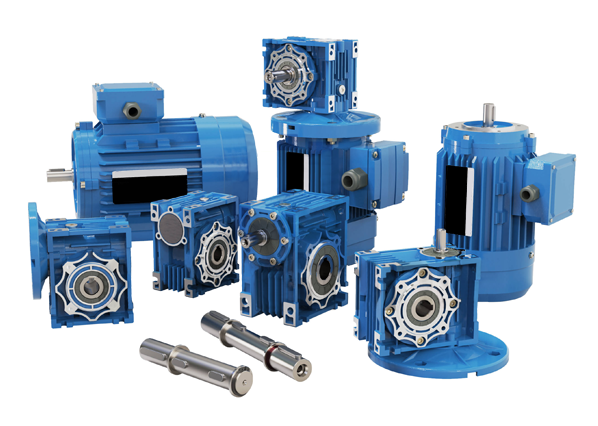
Features: High transmission efficiency, strong load-bearing capacity, compact structure, smooth transmission, long service life
It mainly relies on the meshing of gears with different numbers of teeth to achieve deceleration. The high-speed rotation of the motor is transmitted to the small gear through the input shaft, and the small gear then drives the large gear that meshes with it to rotate. Due to the larger number of teeth on the large gear than on the small gear, the speed is reduced and the torque is increased.
Structural composition:
Box: Provides support and protection, accommodates internal components, and ensures good lubrication and sealing.
Gear set: including the driving gear (small gear) and the driven gear (large gear), it is the core component for achieving deceleration.
Shaft: used to support and fix gears, transmitting torque.
Bearings: Reduce friction and wear of the shaft during rotation, ensuring smooth operation of the shaft.
Lubrication and sealing system: Ensure that gears and bearings are adequately lubricated and prevent lubricant leakage and impurities from entering.
Gear reducers are widely used in various industrial production equipment, such as lifting machinery, metallurgical equipment, mining machinery, chemical equipment, food machinery, etc.
Different types of reducers, such as gear reducers, worm gear reducers, planetary reducers, etc., may have different structures and working principles, but overall they are based on the above basic principles and structural components. In practical applications, selecting a suitable reducer requires consideration of multiple factors, such as transmission ratio, output torque, speed, efficiency, accuracy, reliability, etc. At the same time, it is necessary to select and design the gearbox according to specific working conditions and requirements to ensure that it can operate normally and meet usage requirements.
Related News