
Exchange small knowledge on motor speed regulation
Release Time:
2025-02-13
A three-phase asynchronous motor is a type of induction motor that is powered by a 380V three-phase AC current (with a phase difference of 120 degrees). Due to the fact that the rotor and stator of a three-phase asynchronous motor rotate in the same direction but at different speeds, there is a slip rate, hence it is called a three-phase asynchronous motor.
Exchange small knowledge on motor speed regulation
Introduction to Three phase Asynchronous Motor
A three-phase asynchronous motor is a type of induction motor that is powered by a 380V three-phase AC current (with a phase difference of 120 degrees). Due to the fact that the rotor and stator of a three-phase asynchronous motor rotate in the same direction but at different speeds, there is a slip rate, hence it is called a three-phase asynchronous motor.
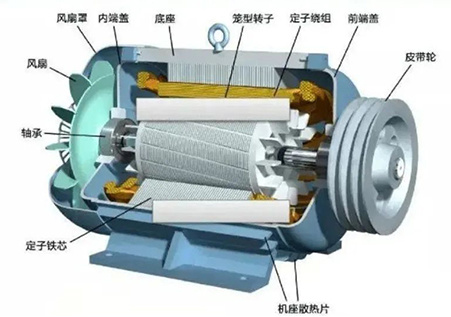
A three-phase asynchronous motor consists of two basic parts: a fixed stator and a rotating rotor. The rotor is installed in the stator cavity and supported on two end caps with bearings. In order to ensure that the rotor can rotate freely inside the stator, there must be a gap between the stator and the rotor, called an air gap. The air gap of an electric motor is a very important parameter, and its size and symmetry have a significant impact on the performance of the motor.
The working principle of an electric motor is based on the laws of electromagnetic induction, full current, circuit, and electromagnetic force.
After the stator of a three-phase asynchronous motor is connected to a three-phase power supply, a circular rotating magnetic flux is formed inside the motor. The circular rotating magnetic flux is dense, and the generated magnetic field rotates in space, which is called a rotating magnetic field. The speed is determined by the number of motors and the frequency of the power supply. When the magnet rotates clockwise, the magnetic field lines cut through the rotor guide bars, and an electromotive force e is induced in the guide bars. The direction of electromotive force is determined by the right-hand rule. Because motion is relative, if the magnet remains stationary and the rotor bar rotates counterclockwise, an electromotive force e can also be induced in the bar. Due to the short circuit between the rotor bars at the ends, there is a current i in the bars. Without considering the phase difference between the electromotive force and the current, the direction of the current is the same as that of the electromotive force. The current interacts with the magnetic field of the rotating magnet, causing the rotor bar to experience an electromagnetic force F. The direction of the electromagnetic force can be determined using the left-hand rule. The rotor is subjected to force, generating torque T, which becomes electromagnetic torque in the same direction as the rotating magnetic flux, and the rotor rotates in that direction.
After the rotor rotates, the speed is n. As long as n<(the synchronous speed of the rotating magnetic flux), there is still relative motion between the rotor bars and the magnetic field, generating electromotive force, current, and force in the same direction as when the rotor is not rotating. The electromagnetic torque T remains counterclockwise, and the rotor continues to rotate, running steadily under the condition of (the load torque of the motor).
There are three elements to the operation of a three-phase asynchronous motor: a rotating magnetic field is required. Secondly, the direction of rotation of the rotor must be the same as that of the rotating magnetic field. Thirdly, the rotor speed must be lower than the synchronous speed, otherwise the conductor will not cut the magnetic field, no induced current will be generated, and no torque will be generated. The motor will stop. After stopping, the speed slows down. Due to the speed difference, the rotor starts to rotate again. Therefore, as long as the rotating magnetic field exists, the rotor will always lag behind the synchronous speed in rotation.
Related News