
What is the difference between a variable speed motor and a regular motor?
Release Time:
2025-01-16
As an indispensable power equipment in modern industry and life, electric motors are widely used in various fields. According to different control methods and application requirements, motors can be divided into two categories: speed regulating motors and ordinary motors. Adjustable speed motors have the function of speed regulation, which can automatically adjust the speed according to changes in load to meet the needs of different working conditions; However, ordinary motors do not have speed regulation function and have a fixed speed. This article will compare and analyze the differences between speed regulating motors and ordinary motors from multiple perspectives.
As an indispensable power equipment in modern industry and life, electric motors are widely used in various fields. According to different control methods and application requirements, motors can be divided into two categories: speed regulating motors and ordinary motors. Adjustable speed motors have the function of speed regulation, which can automatically adjust the speed according to changes in load to meet the needs of different working conditions; However, ordinary motors do not have speed regulation function and have a fixed speed. This article will compare and analyze the differences between speed regulating motors and ordinary motors from multiple perspectives.
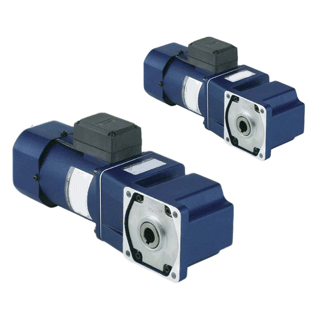
1. Working principle 1.1 Working principle of speed regulating motor
The working principle of a speed regulating motor is mainly to change the input voltage or current of the motor, thereby changing the speed of the motor. Variable speed motors usually use AC or DC power supply, and adjust the motor speed through devices such as frequency converters and controllers. The speed range of the speed regulating motor is wide, and it can be precisely controlled according to actual needs. 1.2 Working principle of ordinary motor
The working principle of a regular motor is relatively simple, mainly by inputting a fixed voltage or current to generate a constant speed of the motor. Ordinary motors usually use AC or DC power supply, but do not have speed regulation function. In practical applications, the speed of ordinary motors is fixed and cannot be adjusted according to changes in load.
2. Structural characteristics
2.1 Structural characteristics of speed regulating motor
The structural characteristics of speed regulating motors are mainly reflected in the following aspects:
(1) Internal structure of motor: Speed regulating motors usually use special winding designs to adapt to different speed regulation requirements. For example, AC speed regulating motors typically use multi pole windings to achieve a wide range of speed regulation.
(2) Controller: Speed regulating motors require specialized controllers such as frequency converters, controllers, etc. to achieve precise control of motor speed.
(3) Sensors: Variable speed motors are usually equipped with sensors, such as current sensors, speed sensors, etc., to monitor the operating status of the motor in real time and provide feedback information to the controller.
2.2 Structural characteristics of ordinary motors
The structural characteristics of ordinary motors are mainly reflected in the following aspects:
(1) Internal structure of motor: The internal structure of ordinary motors is relatively simple, usually using single or double pole windings to meet basic driving needs.
(2) Power supply: Ordinary motors usually use a fixed AC or DC power supply, without the need for additional controllers or sensors.
(3) Installation method: The installation method of ordinary motors is relatively simple, usually using direct connection or with a reducer to meet different installation requirements.
Related News