
Principles, advantages, and selection of deceleration motors
Release Time:
2025-01-08
A reduction motor refers to an integrated body of a reducer and an electric motor (motor). This type of integrated body is commonly referred to as a gear motor or gear motor. Usually, it is integrated and assembled by a professional reducer manufacturer, and then supplied as a complete set together with the motor. It is then integrated and assembled by a professional reducer manufacturer before being supplied as a complete set.
A reduction motor refers to an integrated body of a reducer and an electric motor (motor). This type of integrated body is commonly referred to as a gear motor or gear motor. Usually, it is integrated and assembled by a professional reducer manufacturer, and then supplied as a complete set together with the motor. It is then integrated and assembled by a professional reducer manufacturer before being supplied as a complete set.
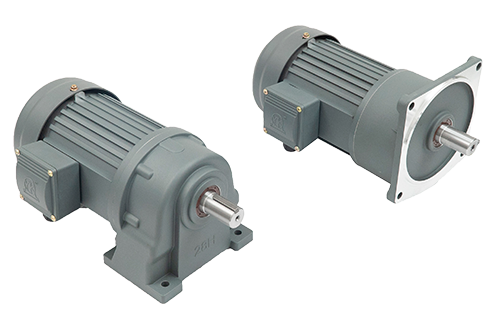
Gearmotors are widely used in industries such as steel and machinery, and their use can simplify design and save space.
After World War II, the rapid development of military electronic equipment promoted the development and production of micro reduction motors and DC reduction motors in countries such as the United States and the Soviet Union. With the continuous development of the deceleration motor industry, more and more industries and enterprises are using deceleration motors, and a batch of enterprises are flooding into the deceleration motor industry market.
Currently, in the global market for micro reduction motors and DC reduction motors, countries such as Germany, France, the United Kingdom, the United States, China, and South Korea maintain their level.
The principle of worm gear reduction motor
Worm gear reduction motor is a power transmission mechanism that uses a gear speed converter to reduce the number of rotations of the motor (motor) to the desired number of rotations and obtain a larger torque.
The functions can be summarized into four points:
1. Reduce speed while increasing output torque. The torque output ratio should be calculated by multiplying the motor output by the reduction ratio, but it should be noted not to exceed the rated torque of the reducer;
2. Deceleration also reduces the inertia of the load, which is the square of the reduction ratio;
3. Its applications can be seen in both high-power transmission work and small load, precise angle transmission;
4. In industrial applications, reducers have the functions of reducing speed and increasing torque.
Related News