
Two important factors affecting the service life of rolling bearings: stress and lubrication
Release Time:
2024-09-11
The selection of bearings is not just about calculating their lifespan, every step from selection, installation, to application is crucial. When encountering bearing problems, stress and lubrication are always the starting points we need to consider. When you are calculating the selection, if there is some missing information or insufficient estimation of the adverse conditions of the application, choosing a large brand of bearings will be more reliable.
Rolling bearings are one of the most critical components in mechanical equipment, and their performance directly affects the operational efficiency and service life of the equipment. Most students may know how to select and calculate the lifespan of rolling bearings, but they may not have a deep understanding of the internal mechanisms of rolling bearings. Therefore, when there are some problems with bearings, they may not have a thorough understanding.
For example, why do bearings from different manufacturers have the same nominal data but different actual lifespans? Why is there a significant difference in the actual performance of lubricating grease with the same viscosity when used on bearings
? If you have similar questions, let's take a look together today.
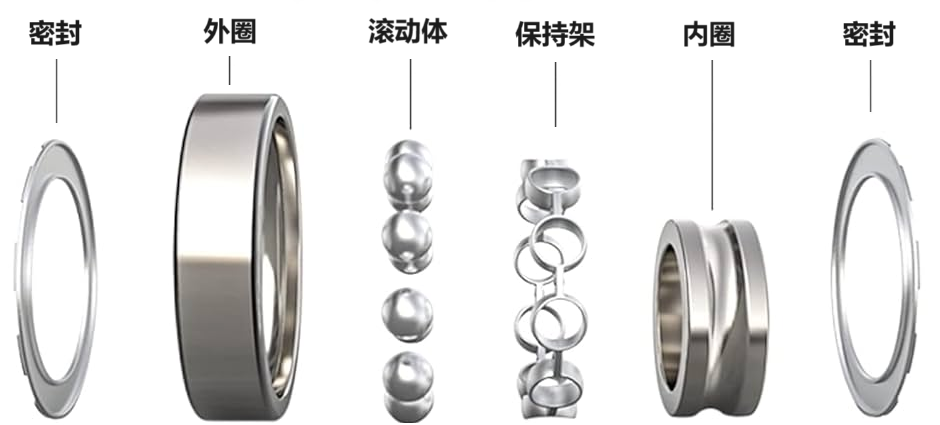
Firstly, what are the functions of rolling bearings? In simple terms, there are two main aspects: supporting the shaft and transmitting the load, reducing friction between moving components. The support and transmission of the load rely on the inner and outer rings and rolling elements, which maintain the auxiliary function of lifting; Reducing friction relies on rolling and lubricants, with sealing serving as an auxiliary function. The two aspects of force and lubrication are the core of rolling bearings, and also the entry point for us to analyze bearing problems.
Understanding Rolling Bearings from a Force Perspective
When rolling bearings support and transmit loads, the inner and outer rings act as direct load-bearing bodies, while the rolling elements act as intermediate force transmission bodies. Due to the very small contact area between the rolling elements and the raceway surfaces, these small contact areas will generate very high stress when the shaft is subjected to external loads. When the stress exceeds the fatigue limit of the material, under the action of cyclic stress, it may lead to contact fatigue failure such as cracks, pits, and peeling on the surface of the material.
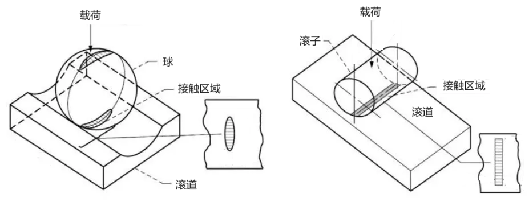
The contact between rolling elements and raceways can be described using Hertz contact theory. But we need to know that it is based on certain assumptions, such as: the contact surface is smooth and frictionless; The contact area is small enough compared to the surface of the object; The materials are all isotropic; Only elastic deformation, etc. For our bearings, it means excellent lubrication, high precision and smoothness of rolling elements and raceway surfaces, high material purity, and moderate load to prevent plastic deformation. Only by approaching the perfect Hertz contact state can the predicted lifespan be more accurate through theory. However, due to the complexity of practical application conditions and the presence of lubrication and pollution, this is difficult to achieve. This is also why many correction factors need to be considered when calculating the lifespan of bearings.
From the perspective of bearing design and manufacturing, continuously optimizing the design of rolling elements and raceway structures to improve stress distribution and reduce the impact of stress concentration; Select higher quality bearing steel materials and heat treatment methods to improve the contact fatigue strength limit of materials, and adopt more precise machining to improve accuracy. These aspects reflect the level of capability and product quality (theoretical durability) of a bearing manufacturer.
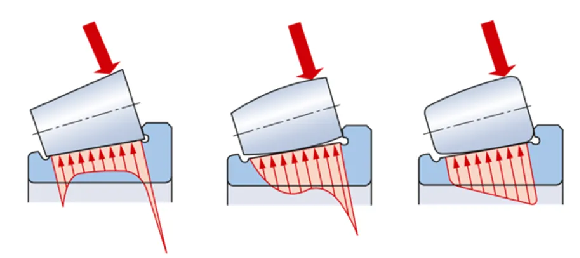
From the perspective of bearing application, as a user, it is important to know how to choose the appropriate bearing based on the load type. For example, from the previous contact area, we know that ball bearings are more suitable for light loads and high speeds due to their small contact area, while roller bearings are more suitable for low-speed heavy loads due to their large contact area. For example, ensuring good bearing seat and shaft accuracy and fit, using reasonable installation tools, etc., to reduce deformation and damage, as this can lead to uneven stress distribution or stress concentration. For example, in the application process, it is necessary to avoid overloading and unbalanced loading. As shown in the figure below, excessive axial load can cause over shoulder (elliptical contact area truncation), which can lead to abnormal stress concentration. In this case, large contact angle bearings should be selected.
Understanding bearings from a lubrication perspective
If the ideal Hertz contact state mentioned earlier is followed, the contact fatigue of the bearing usually occurs at the location of the maximum shear stress on the subsurface. According to actual research, it has been found that bearing fatigue failure more often begins at the contact surface rather than from cracks formed beneath the surface, because the working state of the bearing is not so perfect due to the influence of lubrication conditions.
On the one hand, the rolling elements of a bearing are not in a pure rolling state. Due to differences in linear velocity at different positions, the influence of load and elastic deformation, the presence of inertia and acceleration during starting and stopping, and changes in load and speed, the rolling elements may experience sliding. Compared to rolling, sliding can increase the shear stress on the contact surface. When the lubricant is not selected properly or contaminated, insufficient lubricating oil film or poor wear resistance will result in the contact surface stress exceeding the sub surface stress under high friction conditions (as shown in the figure below), leading to surface failure.
On the other hand, poor lubrication or low bearing speeds that prevent the oil film from forming, as well as poor extreme pressure and anti-wear performance of lubricants, can cause metal to metal contact between rolling elements and raceways, as shown at the microscopic level in the following figure. The uneven and uneven parts of the surface shear each other, and the fatigue caused by stress and the stress concentration of micro friction grooves can lead to the appearance and propagation of cracks, followed by material peeling. As time goes by, the contact surface will become more and more rough, with the appearance of pockmarks. Therefore, it is very important to choose the appropriate type of lubricant to establish a stable lubrication state.
Assuming there is no problem with the selection of lubricant, but if the lubricant is contaminated, such as mixed with dust, iron filings, etc., it will cause scratches and abrasive wear on the contact surface; If water, chemicals, or corrosive gases are mixed in, it can cause the lubricant to deteriorate and reduce its lubrication performance. So it is also very important to keep the lubrication system clean and sealed, and it is necessary to regularly replace and replenish lubricants according to regulations.
Lubrication is not as clear and easy to accurately calculate as the bearing capacity, and it is also the most easily overlooked part. Most of the time, the actual life of bearings does not meet expectations, which is closely related to poor lubrication conditions. We know that lubricating grease is mainly composed of three parts: base oil+thickener+additive; Among them, base oil accounts for about 80-95%; Thickener accounts for about 2% -20%; Additives account for approximately 0-15%. The differences in the performance of lubricating grease from different manufacturers lie in the quality of different base oils, the quality and types of thickeners and additives used (see table below), and the optimization and adjustment of formula composition.
summary
The selection of bearings is not just about calculating their lifespan, every step from selection, installation, to application is crucial. When encountering bearing problems, stress and lubrication are always the starting points we need to consider. When you are calculating the selection, if there is some missing information or insufficient estimation of the adverse conditions of the application, choosing a large brand of bearings will be more reliable.
Related News