
What are the characteristics of hard toothed gear reducers? I'll tell you today
Release Time:
2024-12-26
There are four series of hard tooth surface reducers, also known as the four series reducers. Among them, three series are hard tooth surface gear reducers, and there is also a series of hard tooth surface reducers that combine worm gear and gear. So it is called a hard tooth surface gear reducer, and the gears are definitely different from other gear reducers. Today, let's explore the gear characteristics of hard tooth surface gear reducers together.
There are four series of hard tooth surface reducers, also known as the four series reducers. Among them, three series are hard tooth surface gear reducers, and there is also a series of hard tooth surface reducers that combine worm gear and gear. So it is called a hard tooth surface gear reducer, and the gears are definitely different from other gear reducers. Today, let's explore the gear characteristics of hard tooth surface gear reducers together.
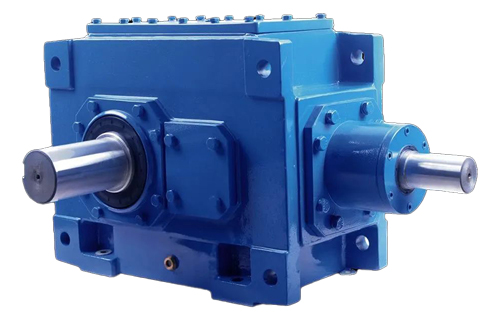
The load-bearing capacity of gear teeth is related to the hardness of the gear. The higher the hardness of the gear, the stronger the load-bearing capacity. According to the hardness of the tooth surface, gears can be divided into hard tooth surface gears and soft tooth surface gears. The standard for hard tooth surface gears is that the tooth surface hardness of a pair of meshing gears is greater than 350HBS. If the hardness standard is lower than this, it is a soft tooth surface gear.
To increase the hardness of gears, there will definitely be differences in the materials and heat treatment methods used. For example, when using 40Cr, 45 #, 45Mn2 steel, the heat treatment method is generally high-frequency tempering or nitriding treatment; If it is 20Cr, 20CrMnTi, 20CrMnVB, 20VrNiH, etc., carburizing quenching can be used; For example, 38CrMnAI can achieve higher hardness through desalination process, and some special materials require special heat treatment methods.
In addition to materials and heat treatment methods, a good hard tooth surface gear reducer also requires the use of computers to optimize the geometric parameters and displacement coefficients of the gears, calculate the composite stress of the tooth surface and root using computers, comprehensively consider contact strength and bending fatigue strength, determine the set parameters, materials, allowable fatigue strength, hardness curve of the gears, and the depth of the hardened layer on the tooth surface, etc. After a series of optimization calculations, high-precision hobbing machines are used for feed grinding. The grinding degree of the gears is generally selected as level 6 precision, and in the case of particularly high linear velocity, it is level 4-5. When there are special requirements for vibration and noise, the highest precision level that can be achieved is currently level 3. Accuracy.
The development of gear forward heavy load, high speed, high precision, and high efficiency in hard tooth surface gear reducers is gradually pursuing the advantages of small size, light weight, long service life, and economic reliability. Improving the load-bearing capacity of gears, extending gear life, increasing the meshing area of tooth surfaces, and improving gear transmission efficiency are also the bottlenecks faced by the gears of several hard tooth surface gear reducers.
Related News