
The difference between ordinary motor, deceleration motor, stepper motor, and servo motor
Release Time:
2024-12-20
Electric motor, commonly known as "motor", refers to an electromagnetic device that converts or transfers electrical energy based on the law of electromagnetic induction. It is represented by the letter "M" (formerly "D") in circuits. Its main function is to generate driving torque as a power source for electrical appliances or various machinery.
Electric motor, commonly known as "motor", refers to an electromagnetic device that converts or transfers electrical energy based on the law of electromagnetic induction. It is represented by the letter "M" (formerly "D") in circuits. Its main function is to generate driving torque as a power source for electrical appliances or various machinery.
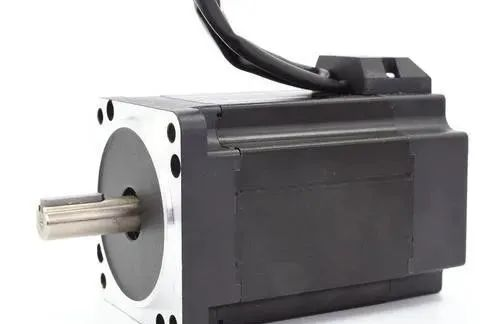
Ordinary motors are commonly seen in electric toys, razors, and other devices. Generally, there are only two pins, and connecting the positive and negative terminals of the battery to the two pins will cause the motor to rotate. Then, if the positive and negative terminals of the battery are connected in opposite directions to the two pins, the motor will also rotate in the opposite direction. This type of motor has the characteristics of high speed and low torque, and is generally not directly used in smart cars.
When the DC power supply supplies power to the armature winding through the electric brush, the current flowing in the same direction can pass through the N-pole lower conductor on the surface of the armature. According to the left-hand rule, the conductor will be subjected to a counterclockwise torque. The conductor under the S pole on the surface of the armature also flows current in the same direction, and according to the left-hand rule, the conductor will also be subjected to a counterclockwise torque. In this way, the entire armature winding, i.e. the rotor, will rotate counterclockwise, and the input DC electrical energy will be converted into mechanical energy output on the rotor shaft. Composed of stator and rotor, stator: base, main magnetic pole, reversing pole, electric brush device, etc; Rotor (armature): armature core, armature winding, commutator, shaft, fan, etc.
A deceleration motor is a combination of an ordinary motor and a gearbox, which reduces the speed and increases the torque, making the ordinary motor more widely applicable.
This type of integrated body is usually referred to as a gear motor or gear motor, and is usually assembled and supplied as a complete set by a professional gearbox manufacturer. Deceleration motors are widely used in industries such as steel and machinery. The advantages of using a deceleration motor are simplified design and space saving. After World War II, the rapid development of military electronic equipment promoted the development and production of micro reduction motors and DC reduction motors in countries such as the United States and the Soviet Union. With the continuous development of the deceleration motor industry, more and more industries and enterprises are using deceleration motors, and a group of enterprises have also entered the deceleration motor industry.
Currently, countries such as Germany, France, the United Kingdom, the United States, China, and South Korea maintain a leading position in the global market for micro reduction motors and DC reduction motors. The Chinese micro reduction motor and DC reduction motor industry was founded in the 1950s. Starting from meeting the needs of supporting weapons and equipment, it has gone through stages of imitation, self design, research and development, and large-scale manufacturing. It has formed an industrial system with complete product development, large-scale production, key components, key materials, specialized manufacturing equipment, testing instruments, and continuously improving internationalization.
Related News