
Detailed explanation of the structure and working principle of AC electric motors
Release Time:
2024-12-19
As an important component of electrical engineering, AC motors are widely used in industry and households. This article will provide a detailed introduction to the structure and working principle of AC motors, helping everyone to gain a deeper understanding of this key knowledge point.
As an important component of electrical engineering, AC motors are widely used in industry and households. This article will provide a detailed introduction to the structure and working principle of AC motors, helping everyone to gain a deeper understanding of this key knowledge point.
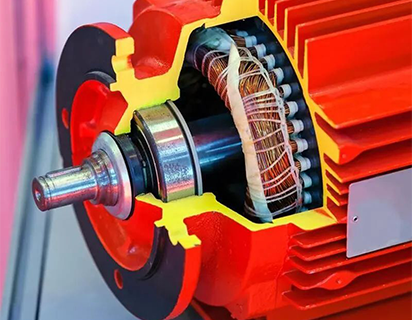
1、 Basic structure of AC electric motor
1.1 Stator
The stator is the stationary part of an electric motor, mainly composed of the stator core and stator winding.
Stator core: usually made of stacked silicon steel sheets, used to reduce eddy current losses.
Stator winding: embedded in the stator core slot, AC power is applied to generate a rotating magnetic field.
1.2 Rotor
The rotor is the rotating part of an electric motor, mainly in two types: squirrel cage and wound rotor.
Squirrel cage rotor: composed of copper or aluminum bars, connected at both ends with short-circuit rings, with a simple structure and wide application.
Wound rotor: composed of windings, connected to external circuits through slip rings and brushes, suitable for situations requiring speed regulation.
2、 Working principle of AC electric motor
2.1 Generation of Rotating Magnetic Field
When three-phase AC power is applied to the stator winding, a rotating magnetic field is generated. Let the three-phase windings be A B、C, After the introduction of three-phase AC power, the magnetic field rotates in the direction of A → B → C.
2.2 Force and Rotation of the Rotor
The rotating magnetic field cuts the rotor conductor, and according to the law of electromagnetic induction, induced current is generated in the rotor conductor. The interaction between induced current and rotating magnetic field generates electromagnetic force, causing the rotor to rotate following the magnetic field.
3、 Example analysis
Example: Working process of three-phase asynchronous motor
Assuming a three-phase asynchronous motor, the stator winding is fed with three-phase alternating current with a frequency of 50Hz.
Rotating magnetic field formation: Three phase currents generate a magnetic field in the stator winding that rotates at a synchronous speed (n=120f/p, f is the frequency, p is the number of pole pairs).
Rotor induced current: The rotating magnetic field cuts the rotor conductor, generating induced current.
Rotor rotation under force: The induced current interacts with the rotating magnetic field, causing the rotor to rotate at a speed slightly lower than the synchronous speed.
4、 Summary
The AC motor generates a rotating magnetic field through the stator winding, and the rotor rotates under the action of electromagnetic force, achieving the conversion of electrical energy to mechanical energy. Mastering its structure and working principle is crucial for understanding and applying AC motors.
Related News