
Working principle and application of gear reducer
Release Time:
2024-12-18
Gear reducer, as an important mechanical transmission device, has a wide range of applications in industrial production. Through a deep understanding of its working principle, type, application, and precautions, we can better choose and use reducers, improve production efficiency and quality. Meanwhile, with the continuous advancement and innovation of technology, gear reducers are also constantly developing and improving, providing more efficient, reliable, and intelligent transmission solutions for industrial production.
Basic principles of gear reducers
A gear reducer is mainly composed of an input shaft, an output shaft, and a set of gears of different sizes. Its working principle can be simply described as: using small gears to drive large gears, transmitting power through the meshing between gears, thereby achieving a decrease in speed and an increase in torque. Specifically, when the small gear on the input shaft rotates, due to the difference in the number of teeth, it will drive the large gear on the output shaft to rotate at a slower speed. During this process, the decrease in speed is directly proportional to the ratio of the number of teeth on the gear, that is, the ratio of the number of teeth on the small gear to the number of teeth on the large gear is the transmission ratio. Meanwhile, due to the inverse relationship between torque and rotational speed, as the rotational speed decreases, the torque will correspondingly increase.
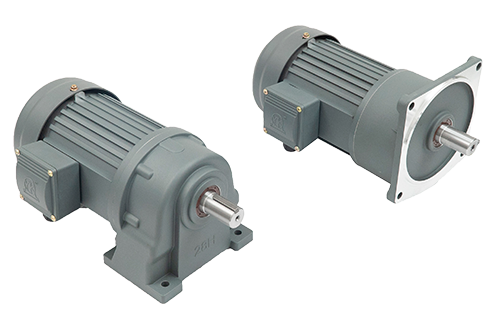
Single stage cylindrical gear reducer: suitable for situations where the reduction ratio is between 3 and 5. Its structure is simple, easy to manufacture and maintain, but the reduction ratio is relatively small.
Single stage bevel gear reducer: suitable for situations where the reduction ratio is between 2 and 4. The arrangement of bevel gears can reduce the size of the gears, making it easier to process and install. However, its reduction ratio is also relatively small.
Cone and cylindrical gear reducers: suitable for situations where the reduction ratio is between 8 and 15. This reducer combines the advantages of bevel gears and cylindrical gears, and has high transmission efficiency and load-bearing capacity.
Worm gear reducers: There are mainly various types of reducers, including cylindrical worm gear reducers, circular arc worm gear reducers, cone worm gear reducers, and worm gear reducers, among which cylindrical worm gear reducers are the most commonly used. Worm gear reducers are suitable for situations where the reduction ratio is between 10 and 80. Its structure is compact, with a large transmission ratio, but the transmission efficiency is relatively low, making it suitable for low-power, gap working environments.
Planetary gear reducer: composed of a large gear and multiple internal small gears, similar to the operation of planets in the universe. Planetary reducers have the characteristics of high rigidity, high precision (up to 1 point per stage), high transmission efficiency (97%~98% per stage), high torque to volume ratio, and lifetime maintenance free. Therefore, it is often installed on stepper motors and servo motors to reduce speed, increase torque, and match inertia.
Application of gear reducer
Gear reducers are widely used in various transmission equipment that requires low speed and high torque, such as:
1. Lifting equipment: such as cranes, lifts, etc., need to withstand large loads and provide stable power output.
2. Metallurgical equipment, such as rolling mills, continuous casting machines, etc., need to withstand harsh environments such as high temperature and high pressure, while requiring precise transmission control.
3. Chemical equipment, such as mixers, reaction vessels, etc., need to withstand corrosive media and high temperature and high pressure conditions, while also requiring stable stirring effects.
4. Conveyor equipment: such as belt conveyors, chain conveyors, etc., need to continuously and stably transport materials, while requiring low noise and vibration.
5. Automation equipment: such as robots, automated production lines, etc., require precise transmission control and high motion accuracy.
Gear reducer, as an important mechanical transmission device, has a wide range of applications in industrial production. Through a deep understanding of its working principle, type, application, and precautions, we can better choose and use reducers, improve production efficiency and quality. Meanwhile, with the continuous advancement and innovation of technology, gear reducers are also constantly developing and improving, providing more efficient, reliable, and intelligent transmission solutions for industrial production.
Related News