
Characteristics of self-locking function of worm gear reducer
Release Time:
2024-12-14
What is self-locking function The self-locking function of the worm gear reducer refers to the fact that under certain conditions, the worm gear transmission can only be driven by the worm wheel to rotate, and cannot be driven by the worm wheel to rotate.
What is self-locking function
The self-locking function of the worm gear reducer refers to the fact that under certain conditions, the worm gear transmission can only be driven by the worm wheel to rotate, and cannot be driven by the worm wheel to rotate.
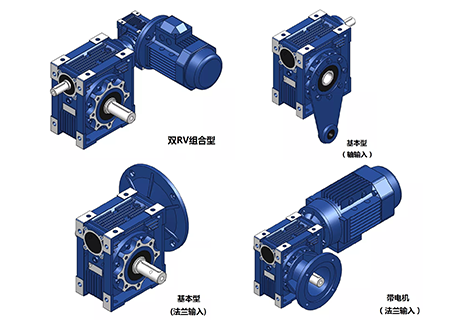
When the helix angle of the worm gear is less than the equivalent friction angle of the meshing surface, the worm gear reducer has self-locking function
What is the principle of self-locking of worm gear reducer
The self-locking of worm gear reducers requires certain conditions to be met. Applying reverse torque to a worm gear reducer will generate a reverse efficiency of η '=2-1/η, which is significantly lower than the forward efficiency of η. Generally, when the forward efficiency of η ≤ 0.5, the worm gear reducer will exhibit a self-locking state. Meanwhile, not only a small number of high speed ratio worm gear reducers have static self-locking, and the self-locking situation can be affected by various factors such as manufacturing accuracy and lubrication conditions.
The self-locking principle of worm gear reducer is:
When the lead angle of the worm is less than the equivalent friction angle between the meshing teeth, the mechanism has self-locking properties and can achieve reverse self-locking, that is, only the worm can drive the worm wheel, not the worm wheel. The self-locking worm mechanism used in other machinery can provide safety protection through its reverse self-locking property.
In the transmission mode of the reducer, worm gear transmission has characteristics that other gear transmissions do not have. Generally, the worm gear can rotate the worm gear relatively easily, but the worm gear is difficult to rotate. This is mainly due to the structural characteristics of the worm gear and the presence of certain friction during the transmission process.
The self-locking function of the worm gear transmission method is of great use in mechanical applications, such as in winches, conveying equipment, and other fields. However, it is precisely because of the friction transmission method of worm gear that its transmission efficiency is much lower compared to gear transmission.
Not all worm gear reducers have good self-locking function. The self-locking function of the worm gear requires a certain speed ratio condition to be achieved, which is closely related to the lead angle of the worm gear. Generally speaking, the self-locking function of worm gears with low speed ratios is relatively less ideal.
Related News