
Working principle of brushless motor
Release Time:
2024-12-05
Brushless DC motors use semiconductor switching devices to achieve electronic commutation, which replaces traditional contact commutators and brushes with electronic switching devices. It has the advantages of high reliability, no commutation sparks, and low mechanical noise. Widely used in tape recorders, video recorders, electronic instruments, and automated office equipment.
Brushless DC motors use semiconductor switching devices to achieve electronic commutation, which replaces traditional contact commutators and brushes with electronic switching devices. It has the advantages of high reliability, no commutation sparks, and low mechanical noise. Widely used in tape recorders, video recorders, electronic instruments, and automated office equipment.
A brushless DC motor consists of a permanent magnet rotor, a multi pole winding stator, a position sensor, etc. The position sensor converts the current of the stator winding in a certain order according to the change of the rotor position (i.e. detects the position of the rotor magnetic pole relative to the stator winding, generates a position induction signal at a determined position, and controls the power switch circuit after processing by the signal conversion circuit to switch the winding current according to a certain logical relationship) The working voltage of the stator winding is provided by an electronic switch circuit controlled by the output of the position sensor.
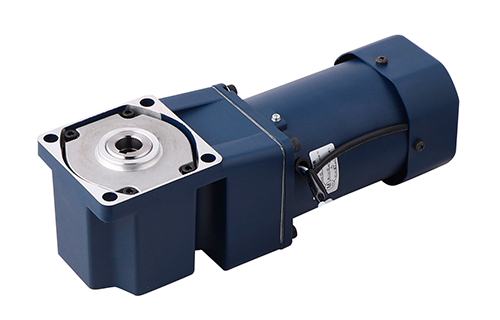
There are three types of position sensors: magnetic sensitive, photoelectric, and electromagnetic
For brushless DC motors with magnetic position sensors, the magnetic sensor components (such as Hall elements, magnetic diodes, magnetic sensitive transistors, magnetoresistors, or dedicated integrated circuits) are installed on the stator assembly to detect magnetic field changes caused by the rotation of permanent magnets and rotors
For brushless DC motors with photoelectric position sensors, the photoelectric sensors are arranged in a certain position on the stator assembly, and the rotor is equipped with a light shielding plate. The light source used for illumination is light-emitting diodes or small bulbs. When the rotor rotates, the photosensitive elements on the stator will intermittently generate pulse signals at a certain frequency due to the effect of the light shielding plate.
A brushless DC motor with an electromagnetic position sensor is equipped with electromagnetic sensor components (such as coupling transformers, proximity switches, LC resonant circuits, etc.) installed on the stator assembly. When the position of the permanent magnet rotor changes, the electromagnetic effect will cause the electromagnetic sensor to generate a high-frequency modulation signal (whose amplitude varies with the rotor position).
The selection of brushless DC motors: Brushless DC motors are widely used in industries such as artificial intelligence, automotive, medical equipment, and industrial automation due to their long lifespan, low noise, and high torque. Due to their different specifications and models, it is very important to choose brushless DC motors to meet product performance requirements
1. Specification selection
When the power supply voltage is adjustable, the specifications of the DC brushless motor with torque and speed close to the corresponding rated values of the product can be selected according to actual needs, and the required speed can be obtained by changing the voltage; When the power supply voltage is fixed, if there is no suitable brushless DC motor to choose from, the appropriate specifications can be selected according to the torque, and the voltage and speed of the product can be adjusted appropriately.
2. Power selection
The power output of the motor is limited. If the power selection of the brushless motor is too small, the motor will overload when the load exceeds the rated output power. If overloaded, the motor will generate phenomena such as heating, vibration, speed decrease, and abnormal noise. If severely overloaded, the motor will be burned out. If the power is too high, it will cause economic waste. Therefore, the rational use of motors is very important in selecting motor power.
3. Selection
High efficiency, low price, and low temperature rise ferrite permanent magnet DC motors should be preferred. Aluminum nickel cobalt permanent magnet DC motors or rare earth permanent magnet DC motors should only be selected when performance requirements are strict, the size is small, and the ambient temperature is high. Magnetic DC motors should be considered.
Related News