
What is the difference between harmonic reducer and RV reducer?
Release Time:
2024-11-29
Harmonic gear reducers can be divided into single wave, double wave, and three wave types based on their mechanical wave number, with the most commonly used being double wave transmission. In harmonic drive, the difference in the number of teeth between the rigid and flexible wheels should be equal to an integer multiple of the mechanical wave number, usually taken as equal to the wave number.
Harmonic reducers are widely used in aviation, aerospace, energy, navigation, shipbuilding, biomimetic machinery, general military equipment, machine tools, instruments, and electronic devices.
Working principle of harmonic reducer
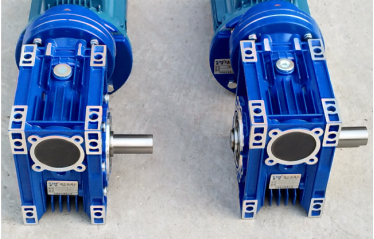
Harmonic reducer, also known as harmonic gear reducer, is a type of reduction device composed of three basic components: a fixed internal toothed rigid wheel, a flexible wheel (i.e. an elastic thin-walled sleeve connected to the driven shaft) that makes a gear ring on the busbar at the beginning of the flexible wheel, and a wave generator that causes radial deformation of the flexible wheel.
Before assembly, the flexible wheel and its inner hole are circular. When the wave generator is installed in the inner hole of the flexible wheel, due to the length of the wave generator being slightly larger than the diameter of the inner hole of the flexible wheel, the flexible wheel is stretched into an ellipse, forcing the flexible wheel to fully mesh with the fixed rigid wheel in the long axis direction of the ellipse and completely separate in the short axis direction. The teeth in other places depend on the rotation position of the flexible wheel, either in the "meshing" state or in the "meshing out" state. Due to the fixed rigid wheel, when the wave generator rotates counterclockwise, the flexible wheel rotates clockwise.
When the wave generator rotates continuously, the long and short axes of the flexible wheel, as well as the positions of "engagement" and "disengagement", change continuously. The flexible wheel teeth shift from engagement to disengagement, then from engagement to disengagement, and from disengagement to disengagement. In this way, the cycle of engagement, disengagement, disengagement, engagement, and disengagement forces the flexible wheel to rotate continuously.
During the rotation of the flexible wheel with the wave generator, one tooth portion of the flexible wheel changes from meshing with one tooth portion of the rigid wheel to meshing with another tooth portion of the rigid wheel again. At this time, the flexible wheel rotates exactly once, and the wave generator rotates many times. The ratio of the number of rotations of the wave generator to the number of rotations of the flexible wheel (1 rotation) is the reduction ratio of the harmonic gear reducer, so its reduction ratio is very large. During the entire movement, the flexible wheel deforms into a continuous harmonic wave shape in the circumferential expansion of the flexible wheel, so this type of transmission is called harmonic gear transmission.
Harmonic gear reducers can be divided into single wave, double wave, and three wave types based on their mechanical wave number, with the most commonly used being double wave transmission. In harmonic drive, the difference in the number of teeth between the rigid and flexible wheels should be equal to an integer multiple of the mechanical wave number, usually taken as equal to the wave number.
Related News